January 11, 2026
·
Updated October 28, 2026
·
13 min read
AI vs Human Writers for SEO: What Actually Differs
A comparison of AI and human writers for SEO content, based on Google's guidance on AI-generated content and five published studies and surveys. It covers cost and time per article, accuracy, rankings, when handcrafted content is worth paying for, and a hybrid workflow.


Short answer: AI writes faster and far cheaper than a human writer, and Google does not penalize content just because AI produced it. Human writers still win on the things a model doesn't have: first-hand experience, original information, checked facts and a name that answers for the page. The evidence points to a hybrid setup for most SEO teams. AI handles research and first drafts, and people handle the angle, the experience, the fact-check and the final edit.
Below you'll find what Google's own documentation says, what ranking studies actually measured (and how far to trust them), the cost per article on each side, when handcrafted SEO content is worth it, and a who-does-what table you can copy into your process. If you're new to the topic, start with how AI content generation works.
AI vs human writers at a glance
The table compares an unedited AI draft, a freelance human writer and a hybrid workflow on the factors that decide whether an SEO article is worth publishing. Costs assume a 1,500-word blog post. Each figure is sourced in the sections below.
| Factor | Unedited AI draft | Human writer | Hybrid (AI draft + human edit) |
|---|---|---|---|
| Cost per article | About $2.50–$5.50 in tool fees on 2026 plans | $375–$675 at EFA blog-post rates | Tool fee plus editor hours |
| Time to a draft | Minutes | 3 hours 20 minutes on average to write a post (Orbit Media, 2026) | Minutes, then review time |
| Factual risk | High: models predict likely words and can invent details | Depends on the writer’s checking | Low if every claim is verified |
| First-hand experience | None of its own | Yes, if the writer has done the thing | Added in a human pass |
| Originality | Recombines what’s already published | Can add original data, interviews, tests | The human adds the original part |
| Voice | Generic unless guided and edited | Distinct | Edited into your voice |
| Scaling | Easy, but mass pages with no added value break Google’s spam policy | Limited by writer hours | Limited by review capacity |
| Accountability | None; Google advises against AI bylines | A named author | A named editor |
Two rows matter more than the rest. Cost is where AI wins, by roughly 70 to 270 times on tool fees alone. Accountability is where it can’t compete, because a model can’t stand behind a claim or correct it later. The hybrid column is there to keep the first advantage without giving up the second.
Does Google penalize AI content?
No, not for being AI-generated. Google set out its position in a February 2023 post on AI-generated content. Its ranking systems aim to reward original, high-quality content that shows E-E-A-T (experience, expertise, authoritativeness and trustworthiness), however that content is produced. The post’s FAQ is blunt about AI giving no ranking boost either: “Using AI doesn’t give content any special gains. It’s just content.”
What Google acts on is the purpose of the content and what it adds:
- Scaled content abuse. Google’s spam policies define this as generating many unoriginal pages mainly to manipulate rankings, no matter how they’re made. Using generative AI to produce many pages without adding value for users is one of the listed examples.
- Low-effort main content. The September 2025 edition of Google’s Search Quality Rater Guidelines (section 4.6.6) tells raters to use the Lowest rating when all or almost all of a page’s main content is copied, paraphrased, or auto- or AI-generated with little to no effort, originality or added value. The same section says using generative AI tools doesn’t decide the rating on its own. Rater scores don’t change rankings directly, but they show what Google wants its systems to find.
- Unchecked output. Google’s guidance on using generative AI content says these models predict likely words rather than retrieve facts, so drafts can contain errors. It asks publishers to fact-check and review AI output before publishing, including titles, meta descriptions, structured data and image alt text.
Google’s people-first content guidance also lists using extensive automation to produce content on many topics as a warning sign. So the risk isn’t AI itself. The risk is publishing lots of AI text that readers could get anywhere. These autoblogging mistakes show how that ends up as thin content in Search Console.
What studies say about AI vs human content rankings
Several large studies have run ranking pages through AI detectors, and one ran a controlled experiment. They agree on less than their headlines suggest.
| Study | What was measured | Main finding |
|---|---|---|
| Ahrefs, July 2025 | Top 20 results for 100,000 keywords (about 600,000 pages), scored with Ahrefs’ own detector | 4.6% of pages were pure AI, 13.5% pure human and 81.9% a mix. The correlation between AI share and rank was 0.011, effectively zero |
| Semrush, April 2026 | 42,000 blog pages from the top 10 for 20,000 keywords, classified with GPTZero | Human-written pages held position 1 about 80% of the time and pure AI pages about 9–10% (the post gives both figures). The gap narrows from position 5 down |
| Graphite, June 2024 | 11,994 article URLs from the top 20 for 2,200 keywords, classified with Originality.ai | About 3% of URLs were purely AI-generated. Half of human pages had a best position in the top five, while half of AI pages had their best position on page two |
| Orbit Media blogging survey, 2026 | 1,042 content marketers, self-reported | 92.4% use AI. AI users were no more likely to report strong results than non-users, but non-users were more likely to report disappointing ones |
| Reisenbichler et al., Marketing Science, 2022 | Field experiments in two industries | Machine-generated SEO text edited by humans outranked human-written text, including SEO experts’ text. The authors say the human editor remains essential |
How to read them:
- Detectors guess. Every detector-based study depends on a statistical classifier. Ahrefs notes that its detector works in probabilities and can produce false positives, so treat the percentages as estimates.
- Correlation isn’t cause. Pages at position 1 also tend to have stronger links, better-known brands and more original material. None of the detector studies can separate AI use from those factors.
- The authors have a stake. Ahrefs and Semrush sell SEO and AI content tools, and Graphite is an SEO agency.
The pattern that holds across the three detector studies: pure AI pages are rare at the top and mixed pages are the norm. The one experiment that tested cause and effect favored edited AI drafts. AI involvement doesn’t sink a page. Unedited AI rarely wins position 1.
Where AI drafts fall short
The gaps below are the ones that affect rankings and reader trust. They’re also the parts of an article you shouldn’t delegate.
First-hand experience
Google’s helpful content questions ask whether a page clearly shows first-hand expertise, such as having actually used a product or visited a place. A model has done neither. For product reviews, Google suggests showing how many products were tested, what the results were and evidence such as photos. An AI draft can only describe a test someone else ran.
Original information
Google also asks whether content provides original information, reporting, research or analysis, and whether it adds real value instead of rewriting its sources. An AI draft built from the top results is a summary of what already ranks. That’s close to the paraphrased content the rater guidelines describe. Your own numbers, customer questions, screenshots and opinions are what make the page different.
Factual accuracy
A large language model writes fluent text whether or not the details are right. An October 2025 EBU and BBC study had journalists review more than 3,000 answers about news from ChatGPT, Copilot, Gemini and Perplexity. 45% had at least one significant issue, and 20% had major accuracy problems, including hallucinated details and outdated information. That study tested assistants answering questions, not drafting articles, but the failure looks the same in an SEO draft: a confident sentence with a wrong price, date or name. Models with a training cutoff also miss anything that changed after it.
Accountability and voice
Google’s 2023 FAQ suggests accurate author bylines wherever readers would reasonably ask who wrote a page. It also says giving AI the byline probably isn’t the best way to be transparent about AI use. A model can’t be asked for its source or corrected next month. Voice is the other gap. Unguided AI prose drifts toward the same phrasing on every topic. The humanized content guide covers what editing for voice involves.
Where AI beats a human writer
AI is better at the parts of writing that are about volume, structure and consistency:
- Speed. Orbit Media’s 2026 survey puts the average time to write a blog post at 3 hours 20 minutes. A model produces a draft in minutes, so the bottleneck moves from writing to review.
- Cost. Tool fees per article are a small fraction of a freelance rate (see the next section).
- Research and structure. Google’s generative AI guidance says these tools can be useful for researching a topic and adding structure to original content. Summarizing the top results, collecting the questions people ask and proposing an outline are good jobs for AI.
- Routine, data-driven text. Google’s 2023 post notes that automation has long produced helpful content such as sports scores, weather forecasts and transcripts.
- Metadata and refreshes. Drafting titles, meta descriptions and alt text across hundreds of pages, or flagging old posts with stale figures, is tedious for people and fast for software. Google still asks you to review that output.
None of these replace the human jobs above. They free up the hours to do them.
Cost per article: AI writer vs human writer
The Editorial Freelancers Association’s 2026 rate chart reports what more than 1,100 members charged in 2025. For blog posts, it lists 25–45¢ per word for work-for-hire writing and 25–40¢ for ghostwriting, or $74.50–$87.50 per hour for work-for-hire. AI tool prices below are the published plans as of October 2026.
| Option | Price | Cost per article |
|---|---|---|
| Freelance writer (EFA blog-post rates, work-for-hire) | 25–45¢ per word | $375–$675 for 1,500 words |
| Skribra Starter | $19/month for 5 articles | $3.80 |
| Skribra Pro | $75/month for 30 articles | $2.50 |
| SEObot | $49/month for 9 articles | about $5.44 |
| Outrank | $99/month for 30 articles | $3.30 |
The tool fee isn’t the real cost of an AI article. The editor’s time is. A simple way to budget is the tool fee plus review hours multiplied by your editor’s hourly rate. As an illustration only: if the experience pass and fact-check take two hours at the EFA’s blog rate, that’s about $150–$175 of editor time. That’s still under half the cheapest commissioned post in the table. If your review takes as long as writing from scratch, the AI draft isn’t saving you anything.
For a feature-by-feature comparison of the tools themselves, see this roundup of AI content tools for SEO writing.
Handcrafted vs automated SEO content: when each wins
Handcrafted SEO content means a person researches, writes and optimizes each page. Automated SEO content means software does most of that, from keyword research to publishing. Most teams end up somewhere between the two. Choose by what the page has to prove to the reader:
| Page type | Best approach | Why |
|---|---|---|
| Health, finance, legal | Handcrafted, reviewed by an expert | Google says that on these topics its systems put even more weight on signals of reliability |
| Product reviews, case studies, opinion | Handcrafted | They depend on first-hand testing and evidence |
| Original research, thought leadership | Handcrafted | The value is the data or the view, which only you have |
| Informational guides and how-tos | Hybrid | AI draft, then an experience pass and a fact-check |
| Definitions, glossary entries, FAQs | Hybrid with lighter review | Structure matters most, but facts still get checked |
| Data-driven pages (scores, listings, specs) | Automated, with quality checks | Google cites this kind of automation as helpful, as long as each page adds something |
The 2022 Marketing Science study is the strongest evidence for the middle path. Human-edited machine drafts beat human-only text in rankings, and the authors still called the editor essential. It was published before ChatGPT launched, so treat it as a direction rather than a benchmark for today’s models.
The failure mode at the automated end is publishing without review, which is how sites fill up with thin content. For a task-by-task view of what can be automated safely, see SEO automation: what you can and can’t automate.
A hybrid AI and human workflow: who does what
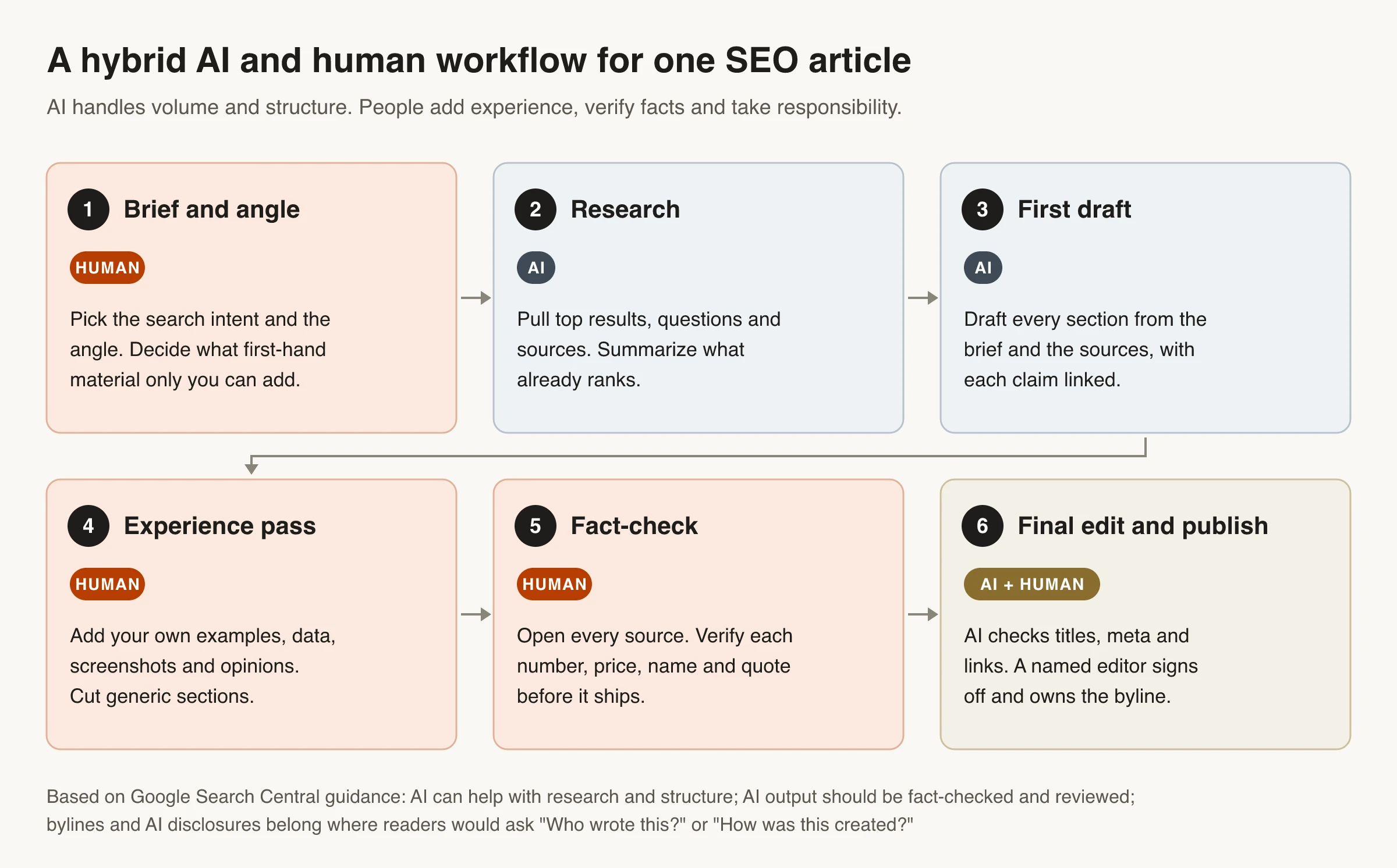
Use the table as a starting split. Move a task to the human column whenever a mistake there would cost you trust.
| Task | Who does it | What the human checks |
|---|---|---|
| Keyword research and SERP summary | AI | Is the intent right? Do you already have a page for it? |
| Angle and outline | Human, with AI suggestions | Does the outline answer the query better than what ranks? |
| First draft | AI | Nothing yet. Speed is the point |
| Examples, data, screenshots, opinions | Human | Only you have them |
| Fact-check: numbers, prices, names, quotes | Human | Open every source and confirm it says what the draft claims |
| Titles, meta descriptions, alt text, internal links | AI drafts, human approves | Google asks for these to be reviewed too |
| Byline and AI disclosure | Human | A real person who can answer for the page |
| Refresh when traffic drops | AI flags, human decides | Has the answer changed, or just the date? |
For the full pre-publish list, work through the AI SEO content checklist. A readability checker helps with long sentences in the final edit. It won’t catch a wrong fact.
Should you disclose AI-written content?
Google doesn’t require a label on every page, but its people-first content guidance and 2023 FAQ suggest one wherever readers would reasonably wonder how a page was made. If automation substantially generated the content, Google suggests explaining how it was used and why it was useful. Bylines belong wherever readers would ask who wrote the page, and Google suggests not naming AI as the author.
In practice:
- Put the editor who checked the page on the byline, with a link to their bio.
- Add a one-line note where it helps, for example “Drafted with AI, then edited and fact-checked by [name].”
- Ecommerce has stricter rules. According to Google’s generative AI guidance, Merchant Center requires AI-generated product titles and descriptions to be labeled as AI-generated, and AI images to carry the matching IPTC metadata.
AI or human writer: which should you choose?
- Trust is the product (health, money, reviews, original research): use a human expert. AI can help with research only.
- Standard SEO guides at volume: go hybrid. Budget for editor hours, not just tool fees.
- Structured, data-driven pages: automate with quality checks, and only publish pages that add something.
- Whichever you choose: have a named person check every fact before the page goes live. That’s the part Google’s guidance, the studies and your readers agree on.
Frequently Asked Questions
- Does Google penalize AI-generated content?
- No, not for how it was made. Google says it rewards helpful, original content however it's produced. It acts against pages mass-produced to manipulate rankings without adding value, which its spam policies call scaled content abuse.
- Can Google detect AI-written content?
- Google hasn't said it ranks pages by whether AI wrote them. It says its systems, including SpamBrain, look for spam patterns however content is produced. The third-party detectors used in ranking studies are probabilistic and can mislabel human writing.
- Is AI content as good as human content for SEO?
- Edited AI content can compete, but unedited AI rarely wins the top spot. Ahrefs found almost no correlation between a page's AI share and its rank, while Semrush found human-written pages held position 1 about 80% of the time.
- Will AI replace human content writers?
- The surveys point to a change in the job rather than a replacement. In Semrush's 2026 survey of 224 SEO and content professionals, 87% described their content as fully human-created or heavily human-led. In Orbit Media's 2026 survey, 92.4% of marketers used AI. The human work is shifting toward angle, experience, fact-checking and editing.
- How much does a human writer cost compared with AI?
- The Editorial Freelancers Association's 2026 chart lists 25 to 45 cents per word for work-for-hire blog posts, or $375 to $675 for 1,500 words. AI tool plans worked out at roughly $2.50 to $5.50 per article as of October 2026, plus the editor time to check and improve each draft.
- Should I disclose that an article was written with AI?
- Google suggests an AI disclosure wherever readers would reasonably ask how a page was created, and advises against listing AI as the author. A named editor on the byline plus a short note on how AI was used covers both.
Get AI Drafts With the Research Done
Skribra researches keywords, writes long-form articles against live sources with links to them, and publishes them to your CMS. You can approve each article before it goes live, so the experience pass and fact-check stay with your team. See how its humanized writing works.
Plans start at $19/month for 5 articles, and every plan comes with a 3-day free trial.
Written by
Skribra
This article was crafted with AI-powered content generation. Skribra creates SEO-optimized articles that rank.
Share: