January 7, 2026
·
Updated October 28, 2026
·
14 min read
10 Best AI Tools for SEO Content Writing (2026)
A comparison of 10 AI tools for SEO content writing, grouped by how much of the job they take over: content optimizers, AI article writers, and end-to-end platforms that research, write and publish. Pricing and features were checked on each vendor's own site in October 2026.

Short answer: if you write the articles yourself, the best AI tool is a content optimizer like Surfer, Frase, Clearscope or NeuronWriter, which scores your draft against the pages already ranking. If you want AI to write the drafts, look at Koala or Jasper. If you want the whole job done, from keyword research to writing, internal links and publishing to your CMS on a schedule, you need an end-to-end platform such as Skribra, Outrank, SEObot or Byword.
These tools are not interchangeable. Most optimizers won't fill your content calendar for you, and most autopilot platforms won't give your writers a live content score. Below is what each one does, what it costs as of October 2026, and a short pilot you can run before you commit. Skribra is our product; it's listed with its real limits, next to the tools we compete with.
The best AI SEO content tools at a glance
Here’s the short version. Prices are the lowest paid plan with monthly billing unless noted, taken from each vendor’s pricing page in October 2026. Plans change often, so confirm before you buy.
| Tool | Type | Best for | Entry price | Free option |
|---|---|---|---|---|
| Surfer | Optimizer + AI writer | Scoring each page against what ranks | $49/mo, billed yearly | “Start for free” (terms not stated) |
| Frase | Research, optimizer + AI agent | Small teams: research to brief to draft | $49/mo ($39 yearly) | 7-day trial, no card |
| Clearscope | Optimizer | Editorial teams with many writers | $129/mo | 14-day trial |
| NeuronWriter | Optimizer | Budget SERP-based scoring | $23/mo | 7-day trial |
| Koala | AI article writer | Fast, SERP-aware drafts | $25/mo | 5,000 words, once |
| Jasper | Brand-voice AI writer | Tone consistency across a team | $69/seat/mo ($59 yearly) | 7-day trial |
| Outrank | End-to-end platform | Daily articles in 150+ languages | $99/mo | Trial (watermarked articles) |
| SEObot | End-to-end platform | Autopilot with an approval step | $49/mo | Refund after first article |
| Byword | End-to-end platform | Bulk volume, up to 300 articles/mo | $99/mo | 5 free articles |
| Skribra | End-to-end platform | Steady publishing plus post-publish upkeep | $19/mo ($16 yearly) | 3-day trial, every plan |
The bigger difference is coverage. The matrix below maps each tool against the stages of SEO content work, from picking the keyword to keeping the article current after it’s live.
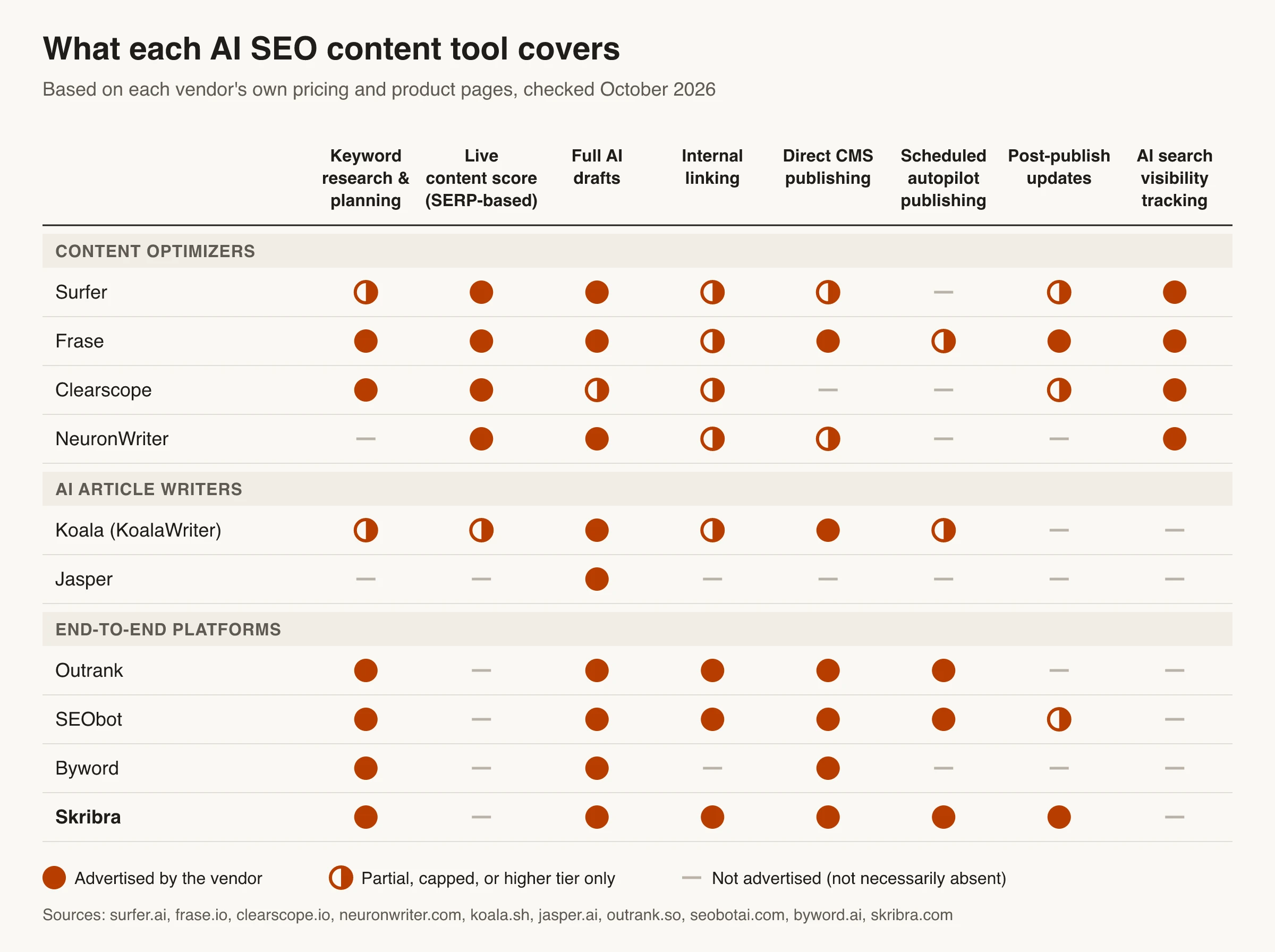
Two patterns stand out. Optimizers own the live content score and AI search visibility tracking but mostly stop before publishing. End-to-end platforms handle keyword-to-publish but don’t give a human writer a score to work against.
Content optimizers: for teams that write their own drafts
Optimizers don’t replace your writers. They analyze the pages that already rank for your keyword and tell you which topics, terms and headings your draft is missing, then score it as you edit. Pick one if a person on your team owns every final draft and you want that draft to be competitive. Most now add an AI drafting assistant and AI search tracking too.
Surfer
Surfer’s editor gives live guidelines and a Content Score while you write, and its AI assistant, Surfy, can outline, draft and edit. According to Surfer’s pricing page, plans billed yearly start at $49/month (Discovery, 120 documents). Keyword research, WordPress and Google Docs integrations, one-click content optimization and a plagiarism checker start on Standard at $99/month billed yearly, and one-click internal linking plus a cannibalization report come with Pro at $182/month billed yearly. The page lists yearly rates only.
- Best for: writers and editors who want a clear target for every page.
- Watch for: no scheduled publishing yet. The Surfy Agent that would publish for you is marked “soon” on Surfer’s homepage.
Frase
Frase now covers SEO research, topic clusters, drafting with an AI agent, SEO and GEO scores, and AI visibility tracking for ChatGPT and Google AI. On Frase’s pricing page, Starter is $49/month ($39 billed yearly) for 1 seat, 1 site and 10 articles a month. Professional, at $129/month ($103 yearly), adds 3 seats, 5 sites, 40 articles, a content calendar and internal linking suggestions. It publishes to WordPress, Webflow, Sanity and Wix (its agent can publish on its own if you allow it), and its Content Guard feature watches published pages for ranking decay and drafts revisions.
- Best for: small teams that want research, brief and draft in one tool.
- Watch for: monthly caps on articles and audited pages. Overage billing is optional and off by default.
Clearscope
Clearscope pairs term suggestions and an AI drafting workflow with query discovery and tracking of where your brand appears in ChatGPT and Gemini. Clearscope’s pricing starts with Essentials at $129/month (50 tracked queries, 50 pages and 20 drafts a month), and Business costs $399/month. Every plan includes unlimited users, and there’s a 14-day free trial.
- Best for: agencies and editorial teams that need several writers working to one standard.
- Watch for: the highest entry price of the optimizers here, and 20 included drafts a month on both self-serve plans (extra drafts cost more).
NeuronWriter
NeuronWriter scores content against top-ranking competitors and NLP terms, can generate full drafts, suggests internal links and tracks your brand’s share of voice across AI models. It’s the cheapest optimizer on this list: per NeuronWriter’s pricing page, Bronze is $23/month for 2 projects, 25 documents and 15,000 AI credits. Gold, at $69/month, adds 75 plagiarism checks and integrations listed as GSC, WP and Shopify. You get a 7-day trial on Gold terms and can request a refund on your first plan within 30 days.
- Best for: solo SEOs and small agencies who want SERP-based scoring on a budget.
- Watch for: tight document and AI-credit caps on the lower plans.
AI article writers: for drafts you edit and publish
AI writers produce the full draft from a keyword or brief. You still review, fact-check and publish. That’s the middle ground between doing everything yourself and handing the whole workflow to a platform.
General chat assistants like ChatGPT and Claude belong here too. They can draft well from a tight content brief, but they don’t see your keyword data or your existing pages unless you paste them in. That’s fine at a few posts a month. It gets slow once you publish weekly.
Koala (KoalaWriter)
KoalaWriter turns a keyword into a full article, using SERP analysis of what currently ranks. From the Professional plan, KoalaLinks indexes your site to add contextual internal links, and the article editor adds an SEO score. It publishes to WordPress, Shopify, Webflow, Ghost or any webhook, either as a draft for review or automatically. Koala’s pricing is word-based: Starter is $25/month for 45,000 words, Professional is $49 for 100,000 words, and Content Calendar Autopilot starts on the $99 Boost plan. The free plan gives you 5,000 words once, with no card required. For a deeper look at how it stacks up against us, see our Skribra vs Koala comparison.
- Best for: affiliate and niche sites that want quick drafts grounded in the current SERP.
- Watch for: at about 2,000 words per article, Starter’s 45,000 words covers roughly 22 articles a month on the default model; Koala counts words at 2x or 3x on its premium models.
Jasper
Jasper is built around brand control: brand voices, knowledge assets, audiences and agents for marketing workflows. On Jasper’s pricing page, Pro costs $69 per seat per month ($59 billed yearly) with 2 brand voices and a 7-day trial. Business is custom-priced. The pricing page doesn’t list a SERP-based content score or scheduled CMS publishing, so SEO teams often pair Jasper with an optimizer.
- Best for: marketing teams producing many content types where consistent tone matters most.
- Watch for: you’ll still need separate tools for keyword research and SERP-based optimization.
End-to-end AI SEO content platforms: research, write and publish
This is the category behind questions like “which AI SEO platforms write fully internally linked, publish-ready articles, not just outlines or briefs?” These platforms pick the keywords, write the article with links and images, and push it to your CMS on a schedule. The trade-off is control: you set direction up front and review the output, instead of shaping each draft line by line. Our guide to AI SEO platform vs SEO suite selection criteria covers when that trade-off makes sense.
Skribra
Skribra is our product, so read this entry with that in mind. You describe your site once. Skribra researches keywords and builds a content calendar, then its main agent researches each topic, outlines it for the search intent, drafts it, and adds internal and external links, images, and an FAQ or video where they fit. It publishes to WordPress, Webflow, Notion, Shopify or a webhook with JSON-LD schema, and pings search engines through IndexNow. You can approve each article or let them auto-publish.
What’s different is the work after publishing. Skribra’s SEO agents refresh pages that sit in striking distance in Search Console, rewrite titles that get impressions but few clicks, fix outdated years, link older posts to newer ones and flag overlapping articles. On the Pro plan, the full set of maintenance agents runs on every article. Our automatic content refresh page explains how that works.
Pricing is per project: Starter is $19/month for 5 articles, Growth $39 for 12, and Pro $75 for 30, each article 1,700 to 3,300 words, and every plan has a 3-day free trial. A one-time $199 plan lets you bring your own OpenAI API key, with limited seats.
- Best for: founders and small teams who want steady publishing on a new or small site without managing writers.
- Watch for: there’s no live content-score editor for human writers, and Starter’s 5 articles a month is about one a week.
Outrank
Outrank’s homepage lists one plan: $99/month for 30 articles (one a day), upgradeable to 60 or 90, in 150+ languages. Per Outrank’s homepage, that includes unlimited keyword research, AI images, YouTube embeds, internal and external links, and publishing to WordPress, Webflow, Notion, Wix, Shopify, Framer, Ghost and others. It also includes optional backlink building: once you turn it on, Outrank places links to your site inside articles it writes for other customers, and you earn credits by hosting links in yours. Trial articles carry an Outrank watermark. Our Skribra vs Outrank breakdown goes deeper on the differences.
- Best for: sites that want daily volume, especially across many languages.
- Watch for: if you turn on backlink building, check how placements work against Google’s link spam policy, which covers link schemes including excessive link exchanges. Outrank doesn’t advertise post-publish updates.
SEObot
SEObot researches your site, audience and keywords, makes a content plan and starts producing articles every week, each up to 4,000 words. According to SEObot’s site, articles include images, YouTube embeds and a fact-checking step, and internal links get re-linked monthly as your library grows. You can approve, decline or edit each article before it goes to WordPress, Webflow, Shopify, Ghost, HubSpot, Framer, Notion, Wix and other platforms. Subscriptions start at $49/month. Instead of a trial, SEObot offers a full refund on the $49 plan if you’re not satisfied after the first article. Here’s our Skribra vs SEObot comparison.
- Best for: teams that want autopilot with an approval step and a long list of CMS options.
- Watch for: the homepage doesn’t say how many articles each plan includes, so confirm that before you buy. Our SEObot pricing breakdown lists the article count for each plan.
Choosing between SEObot and Outrank? Read Outrank vs SEObot for pricing per article, review options and output side by side.
Byword
Byword researches keywords, writes in your brand voice using models from OpenAI, Anthropic and Google, and publishes to WordPress, Webflow and four other CMSs. Byword’s plans scale by volume: Starter is $99/month for 25 articles, Standard $299 for 80, and Scale $999 for 300. You can start free with 5 articles. If you’re weighing it against us, see Skribra vs Byword.
- Best for: programmatic and bulk projects that need hundreds of articles a month.
- Watch for: the entry tier works out to about $4 per article, and the Byword pages we could read don’t mention post-publish updates.
Also worth a look: Autoblogging.ai
Autoblogging.ai is credit-based. Per its pricing page, Starter is $19/month for 40 credits. A standard article costs 1 credit, and SERP analysis, AI images and internal linking each add 1 more, so a Quick Mode article with all three costs 4 credits. It posts on a schedule to WordPress and connects to Shopify, Wix, Webflow and Ghost, and every account gets 10 free credits a month. We compare it with other options in Autoblogging.ai alternatives by use case. Comparing BuzzRank with XEO or XeoRank instead? Read BuzzRank vs XeoRank vs XEO.
How to choose the right AI SEO writing tool
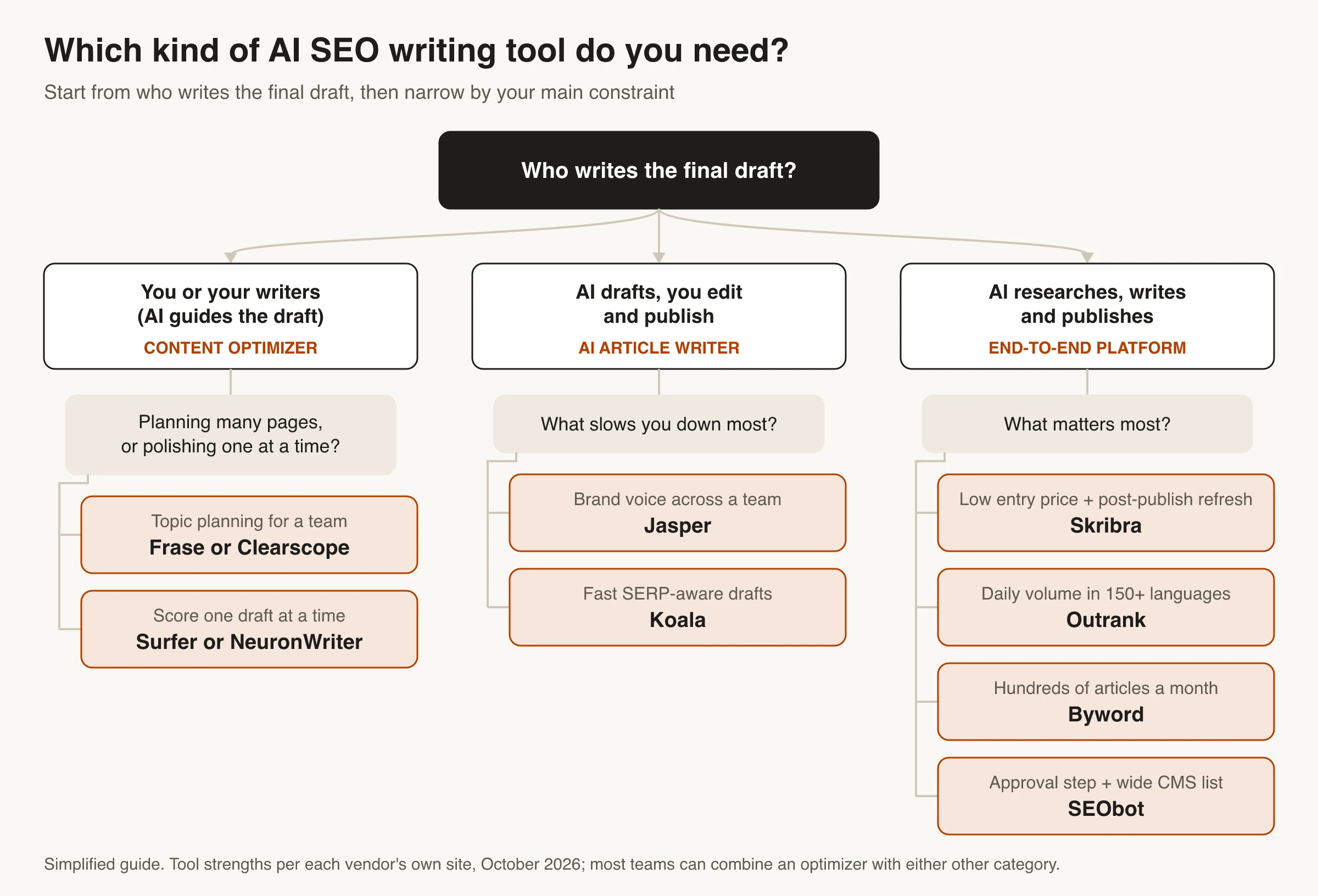
Start with one question: who writes the final draft? The answer puts you in one of the three categories above. Then narrow it down by your main constraint.
What an end-to-end platform should handle
If you’re evaluating an all-in-one platform, check that it handles each of these, not just the drafting:
- Keyword selection from real search demand, with no two articles targeting the same query.
- An intent-matched outline, so a “best tools” query gets a comparison and a “how to” query gets steps.
- Cited research. Claims should link to sources you can verify.
- Internal linking to related posts, plus updates to older posts when new ones go live.
- Technical extras: a meta description, schema markup and an indexing ping.
- Publishing to your CMS, with an optional review step before anything goes live.
- Upkeep after publishing: refreshing stale facts and rewriting titles that get impressions but no clicks.
The first six describe a good article. The seventh decides whether it still ranks in a year.
Compare cost per published article, not plan price
Plan prices hide very different units: documents, words, credits or articles. Convert everything to cost per published article at the volume you’ll actually run. Using the October 2026 entry prices above:
- Skribra: $19 / 5 articles = $3.80 each on Starter; $75 / 30 = $2.50 on Pro.
- Outrank: $99 / 30 articles = $3.30 each.
- Byword: $99 / 25 articles = $3.96 each.
- Frase: $49 / 10 articles = $4.90 each on Starter, before your editing time.
For optimizers and writers, add the hours a person spends editing, fact-checking and publishing. That time is usually a bigger cost than the subscription.
Does AI-written SEO content rank on Google?
Yes, AI-written content can rank, and Google has said so directly. Its guidance on AI-generated content describes a “focus on the quality of content, rather than how content is produced.” What it penalizes is the pattern, not the tool. Under its scaled content abuse policy, generating many pages mainly to manipulate rankings, without adding value for users, is spam however those pages are made.
In practice, that means any tool on this list can produce content that ranks or content that gets demoted. The difference is the process around it:
- Publish only what answers a real query better than the current results. Google’s helpful content guidelines include a self-assessment checklist.
- Fact-check every number and product claim against a primary source.
- Don’t publish near-duplicate pages for every keyword variation.
- Refresh or merge pages that stop earning impressions.
We go through the common failure modes in 9 autoblogging mistakes that trigger thin content issues.
Run a small pilot before you commit
Demos look good in every tool. A short pilot on your own site tells you more:
- Pick 3 to 5 keywords you’d actually publish for, with clear intent.
- Use the same inputs in two tools: the same keyword, brief, audience notes and brand rules.
- Time the editing. Track how long each draft takes to get to “publishable” and how many factual errors you catch.
- Check what ships. Look at the internal links, meta description, schema and images in the published HTML, not the editor preview.
- Watch Search Console for 4 to 8 weeks, tracking indexing, impressions and average position for each page.
If a tool only wins when you rewrite half of every draft, it’s not saving you time. And if writing isn’t your bottleneck, see our guide to AI tools to increase organic traffic beyond writing.
Which AI SEO Content Tool Should You Pick?
- You write, AI guides: Surfer or NeuronWriter for single pages, Frase or Clearscope for planning across a team.
- AI drafts, you edit: Koala for quick SERP-aware drafts, Jasper when brand voice is the bottleneck.
- AI does the whole workflow: Skribra for low entry cost and post-publish upkeep, Outrank for daily multilingual volume, Byword for bulk, SEObot for approval-first autopilot.
Whichever you pick, run the pilot on a few real keywords first and judge the published page, not the demo.
Frequently Asked Questions
- What is the best AI tool for SEO content writing?
- It depends on who writes the final draft. If your team writes, a content optimizer like Surfer, Frase, Clearscope or NeuronWriter helps most. If you want AI to handle research, writing and publishing, an end-to-end platform such as Skribra, Outrank, SEObot or Byword fits better.
- Which AI SEO platforms write fully internally linked, publish-ready articles?
- End-to-end platforms do: Skribra, Outrank and SEObot all advertise internal linking, images and scheduled publishing to your CMS. Koala also adds internal links and can auto-publish, and its calendar autopilot starts on the $99 Boost plan. Optimizers like Surfer and Clearscope help you write and score the draft, but you publish it yourself. Frase is the exception among optimizers: its agent can publish on its own if you allow it.
- Which AI content writing tools include plagiarism checking and SEO scoring?
- Surfer includes a content score and, from its Standard plan, a plagiarism checker. NeuronWriter scores drafts against competitors and includes 75 to 150 plagiarism checks from its Gold plan up. Frase scores drafts for both SEO and GEO, but its pricing page doesn't list a plagiarism checker.
- Is AI-generated content bad for SEO?
- Not by itself. Google says it rewards quality content however it's produced, but its scaled content abuse policy targets mass-produced pages that add no value. Fact-checking, original insight and avoiding near-duplicate pages matter more than which tool wrote the draft.
- Can I review AI-written articles before they publish?
- With most tools, yes. SEObot lets you approve, decline or edit each article, Koala can publish as drafts, and Skribra lets you approve every article or switch on auto-publish. Surfer and Jasper don't publish on their own, so review is built in.
Put Your SEO Content on Autopilot
If the end-to-end route fits your team, Skribra researches keywords, writes long-form articles with internal links and images, publishes them to your CMS, and keeps them updated after they go live.
Plans start at $19/month for 5 articles, and every plan comes with a 3-day free trial.
Written by
Skribra
This article was crafted with AI-powered content generation. Skribra creates SEO-optimized articles that rank.
Share: