July 12, 2026
·
Updated October 28, 2026
·
15 min read
BuzzRank vs XeoRank vs XEO: Which AI SEO Tool Fits?
A comparison of BuzzRank, XeoRank and XEO, three tools sold as AI SEO. It covers what each one automates, pricing and trials, publishing and approval models, backlink programs and Google's link spam policy, and AI-visibility tracking. Vendor facts come from buzzrank.io, xeorank.com and xeoaigeo.com as of October 2026.

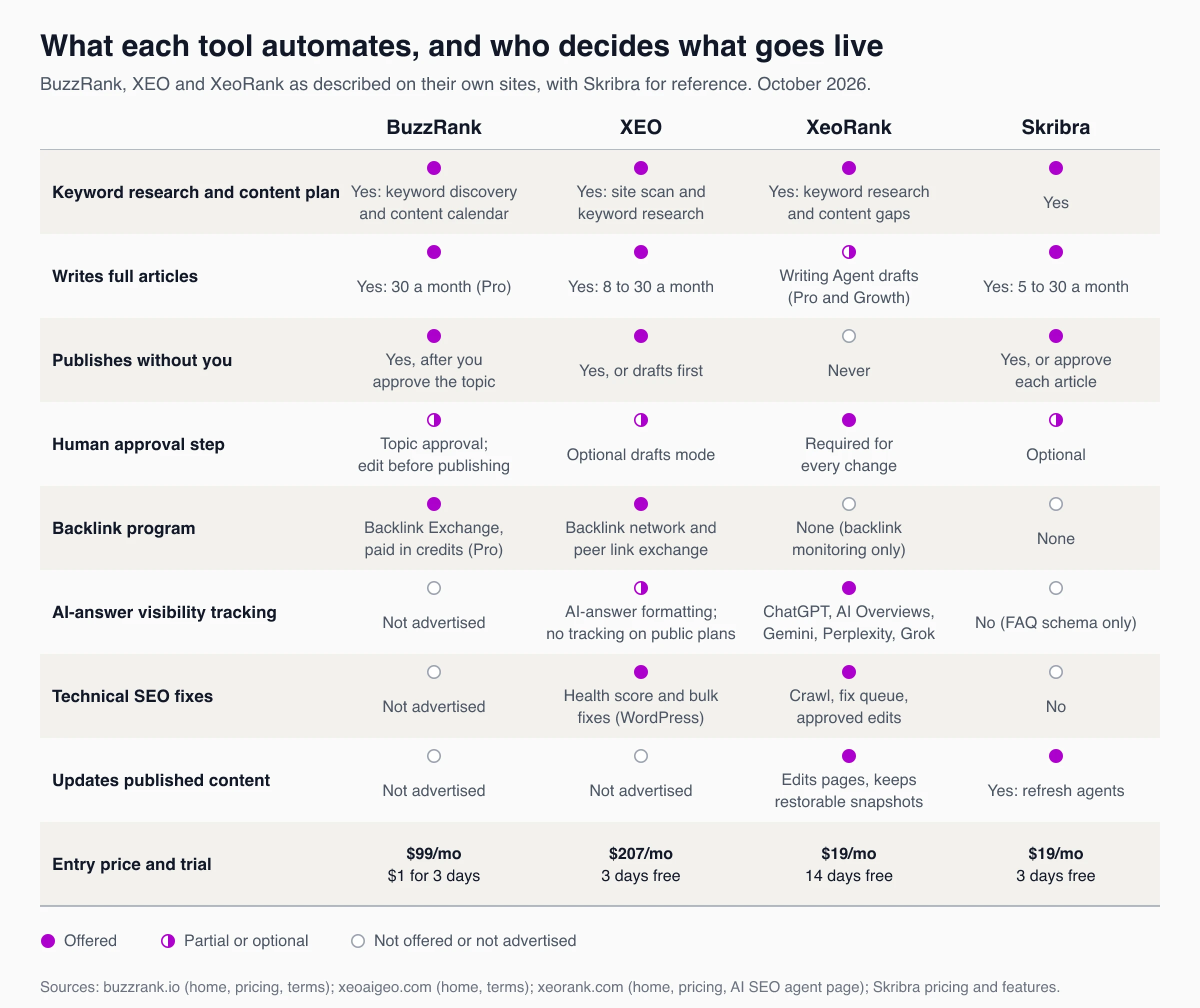
Short answer: BuzzRank and XeoRank aren't really rivals. BuzzRank is a hands-off article autopilot. It costs $99/mo for 30 AI-written articles, publishes them to WordPress or your own API, and adds an optional backlink exchange. XeoRank doesn't run an article autopilot at all. It's an approval-first SEO and AI-visibility workspace, from $19/mo, that finds problems on your site, prepares the fix and ships it only after you say yes.
If you searched for XEO (xeoaigeo.com), that's a third, separate product. It works much like BuzzRank, with autopilot articles plus a backlink network, but plans start at $207/mo for 8 articles. Every vendor fact below was checked on the vendor's own site in October 2026. We make Skribra, a competing autopilot, so it appears only as a reference point near the end.
BuzzRank, XeoRank and XEO: which tool is which
Three similar names get mixed up here, so here’s a quick map first.
- BuzzRank (buzzrank.io) calls itself an “SEO autopilot”. It researches keywords, writes and publishes articles, and runs a backlink exchange between its users. Its terms name CreativeRebels Marcin Jaroszewicz, a business registered in Poland, as the operator.
- XeoRank (xeorank.com) describes itself as “organic search operations” for agencies and growth teams. It covers Google rankings, technical SEO and visibility in AI answers, and every change to your site needs your approval.
- XEO (xeoaigeo.com) is a separate product with a similar name, and neither site mentions the other. It’s an autopilot article tool with a backlink network, much closer to BuzzRank than to XeoRank.
So “BuzzRank vs XEO” compares two autopilots. “BuzzRank vs XeoRank” compares two ways of doing SEO: software that publishes for you, or software that prepares work you sign off on.
BuzzRank vs XeoRank vs XEO at a glance
Everything below comes from each vendor’s homepage, pricing page, docs or terms as of October 2026. Prices use monthly billing.
| BuzzRank | XeoRank | XEO | |
|---|---|---|---|
| What it is | Article autopilot plus backlink exchange | Approval-first SEO and AI-visibility workspace | Article autopilot plus backlink network |
| Entry price | $99/mo (Pro) | $19/mo (Starter, one site) | $207/mo (Starter) |
| Trial | $1 for 3 days, up to 5 articles | 14-day free trial on Starter; first site analysis free | 3 days free; its terms add a 14-day money-back guarantee |
| Articles included | 30 a month | Not sold per article; Writing Agent drafts on Pro and Growth | 8, 16 or 30 a month |
| Publishes without you | Yes, once you approve the topic | Never: every change needs approval | Yes, or saves drafts first if you choose |
| Where it publishes | WordPress (REST API or plugin), webhook, REST API | WordPress and Shopify; Framer and code sites through its agent | WordPress, Wix, Webflow, Shopify, Lovable, Base44 |
| Backlinks | Optional Backlink Exchange on Pro, settled in credits | No link program; backlink monitoring on Pro and Growth | Backlink network and peer link exchange; opt-out in settings |
| AI-answer tracking | Not advertised | ChatGPT, Google AI Overviews, Gemini, Perplexity, Grok | Content formatted for AI answers; no tracking on its public plans |
| Technical SEO fixes | Not advertised | Site crawl, prioritized fix queue, approved edits | Site health score and bulk fixes in your WordPress SEO plugin |
BuzzRank and XEO sit in the same column of the market: both write and publish for you and both bundle link building. XeoRank is the odd one out. It works on the pages you already have and the AI answers you’re missing from, and it never publishes on its own.
BuzzRank: article autopilot with a backlink exchange
BuzzRank’s pitch is simple. You enter your URL, and it plans, writes and publishes SEO articles, then helps you get links through an exchange with other BuzzRank users.
How BuzzRank works
The BuzzRank homepage describes four steps:
- Your URL. BuzzRank runs a technical and visual analysis of your site to build a brand profile.
- AI analysis. It looks for content gaps and keyword opportunities and lays out a content calendar “for months ahead”.
- Publishing. You approve the topic, and the finished article, with images and meta tags, goes to your blog automatically. You can edit it in BuzzRank’s editor before it publishes.
- Link exchange. You trade contextual links with other sites in the network (more on this below).
Listed integrations are WordPress, a WordPress plugin, Google Search Console, DataForSEO and webhook/REST. Semrush and Ahrefs logos also appear, without saying how they’re used.
On WordPress, BuzzRank uses the WordPress REST API or its own plugin to create, update and schedule posts. Other sites can use the webhook integration, which POSTs each article to your endpoint (signed with HMAC-SHA256 if you set a secret), or a REST API integration that calls your CMS directly (Strapi, Sanity, Contentful and Ghost are the examples given). Posts can arrive as drafts, published or scheduled.
BuzzRank pricing and trial
BuzzRank’s pricing page lists two plans:
| Plan | Price | What’s included |
|---|---|---|
| Trial | $1 for 3 days | Up to 5 articles, generation and editing, limited webhook, no Backlink Exchange |
| Pro | $99/mo | 30 articles a month, WordPress, plugin and webhook/REST publishing, 100 backlink credits a month, credit rollover up to 2 months |
That works out to $3.30 per article on Pro. The homepage shows the $99 price next to a crossed-out $200. Extra backlink credits are sold as one-time top-ups: $100 for 200 credits, $200 for 500 and $500 for 1,500. Top-up credits don’t expire.
A few details on the site don’t add up. The pricing page says “No credit card required” under a $1 trial, and its header promises a free trial and exchange access on all plans, while the trial itself is listed without the exchange. A footnote calls one credit “a $1 internal unit”, while the top-ups sell credits for less than $1 each. The page doesn’t say how many sites Pro covers or which languages articles can be written in. You can cancel any time in the app, and the terms say refunds are handled case by case.
How the Backlink Exchange works
BuzzRank describes the exchange as “proof-first”, not a link marketplace. Each link goes through request, approval, placement, verification and settlement. Credits change hands only after BuzzRank verifies the link is placed correctly. The exchange is optional, only available on Pro, and the content pipeline works without it.
The terms add three rules for participants. You may only offer links from domains you own or control, you must keep placed links live for at least 90 days, and you must not take part in “link schemes or manipulative practices”. Whether that’s enough to keep a link exchange safe is a separate question, covered in the backlink section below.
XeoRank: approval-first SEO and AI visibility
XeoRank starts from the opposite assumption: an AI with write access to your live site should ask first. Its homepage says it shows where you’re missing on Google, ChatGPT, Gemini, Perplexity and Grok, “prepares the fix, and publishes it after you approve it”. It says it’s built for agencies, growth teams and technical marketers managing several sites or a large backlog of SEO work.
How XeoRank works
XeoRank’s homepage lays out a four-stage loop:
- Bring the evidence together. Connect Search Console, analytics, your CMS and the sites you manage.
- Work from one queue. Search losses, crawl issues, content gaps and AI-citation opportunities are ranked by likely impact.
- Review the proposed change. You or your client see what will change and why before anything ships.
- Publish and verify. Approved changes go to WordPress or Shopify, with a change history so you can check the result against the original signal.
You can work in the dashboard, the XeoRank CLI, or through its MCP server from Claude, ChatGPT, Codex, Cursor or VS Code. Its AI SEO agent page says the server has more than 200 tools. You ask in plain language, and your assistant runs the crawl, keyword research or rank check.
Edits are guarded by default. WordPress writes stay off for each site until you turn them on, and new pages are saved as drafts. Edits to existing pages apply directly once you approve them. Page content is snapshotted before each change (up to 20 per page), but SEO meta, menus and custom code are not. On WordPress, the agent can write titles and meta descriptions to Yoast, Rank Math or All in One SEO and add schema.
XeoRank pricing
XeoRank’s pricing is per site and paid in credits:
| Plan | Price | Highlights |
|---|---|---|
| Starter | $19/mo, one site | 15,000 credits, weekly Google AI tracking for 20 prompts, rank tracking for 25 keywords, unlimited AI edits, MCP and API access; 14-day free trial, no card |
| Pro | $49 per site/mo | 40,000 credits per site (pooled), 20 prompts tracked weekly on ChatGPT, Google AI Overview, Gemini, Perplexity and Grok, monthly flagship audit, 100 keywords, backlinks every 2 weeks, Writing Agent (10,000 words) |
| Growth | $109 per site/mo | 90,000 credits per site, 50 prompts weekly, larger flagship audit, 2-year history and rollbacks |
Everything else draws on credits, and each action shows its cost before it runs. A Writing Agent draft costs 300 credits per 1,000 words, and a site crawl costs 2 credits per page. Top-ups are $5 for 5,000 credits, $10 for 11,000 and $20 for 24,000, and they never expire. XeoRank’s own example: three sites on Pro cost $147/mo with 120,000 pooled credits. As of October 2026, the page said early access was open with “49 of 100 early-access seats” left, and a Managed plan with a team was available on request.
What XeoRank doesn’t do
XeoRank is unusually direct about its limits. By its own account:
- It doesn’t publish on its own. Every change is a tool call that a person approves. If you want SEO changes “published with nobody checking them”, it says it’s the wrong tool.
- The agent needs your own AI assistant. Your Claude, ChatGPT or Cursor subscription is a separate cost.
- It tracks fewer AI engines than AthenaHQ or Profound.
- It doesn’t estimate prompt volume, so it can’t tell you how many people ask a given question in ChatGPT.
It also isn’t an article autopilot. The Writing Agent produces drafts, but there’s no “30 posts a month, published automatically” mode like BuzzRank or XEO offer.
XEO: autopilot articles at a higher price
XEO (xeoaigeo.com) sells the same promise as BuzzRank: enter your URL, and the tool researches, writes, publishes and builds links. The differences are in price, CMS coverage and an extra SEO health tool.
How XEO works
XEO’s homepage says it scans your site to learn your business, audience and competitors, then writes and publishes articles. Each article includes SERP research, metadata, internal links, a hero image, schema and FAQ blocks formatted for AI answers. It lists a “humanization pass”, fact verification and an “AI detection gate”, without explaining how they work.
Links come from two places. There’s a backlink network of “real websites”, and a peer link exchange that connects XEO users to swap backlinks. Its terms say that by joining the network you agree to host links from other members, and that you can opt out in settings.
XEO also has an SEO health tool. It scores your site from 0 to 100 across meta tags, canonicals, schema, indexability and Open Graph tags, then writes bulk fixes into your WordPress SEO plugin.
It publishes to WordPress, Wix, Webflow, Shopify, Lovable and Base44 (its terms also list Ghost, HubSpot and Framer) and offers to integrate other systems within 72 hours. You can save every article as a draft and switch to full autopilot later.
XEO pricing and trial
XEO’s plans are shown on its homepage (there’s no separate pricing page):
| Plan | Price | Articles | Sites |
|---|---|---|---|
| Starter | $207/mo | 8 a month | 1 |
| Growth | $397/mo | 16 a month | 2 |
| Pro | $747/mo | 30 a month | 3 |
Every plan lists the SEO health check with one-click fixes, the full site audit, AI writing and the backlink network. Pro adds “All CMS” and VIP support. That works out to roughly $25 per article on every plan, about 7.5 times BuzzRank’s $3.30.
The homepage offers “3 Days Free · Cancel anytime”, and the FAQ says you can cancel before billing with no charge. The terms add a 14-day money-back guarantee on all plans.
Two inconsistencies are worth knowing about. The page’s structured data, which search engines can show in results, lists a $29 Starter plan with 5 articles and a $79 Pro plan with unlimited articles, which doesn’t match the plans on the page. The homepage also shows “80+ active websites”, while its meta description says “2,400+ businesses”. This comparison uses the visible prices. Neither customer number, nor the testimonials on the page, could be verified independently.
Pricing compared: cost per article
If what you’re buying is published articles, cost per article is the fairest comparison. XeoRank isn’t in the chart because it doesn’t sell articles. Its Writing Agent drafts are paid for in credits.
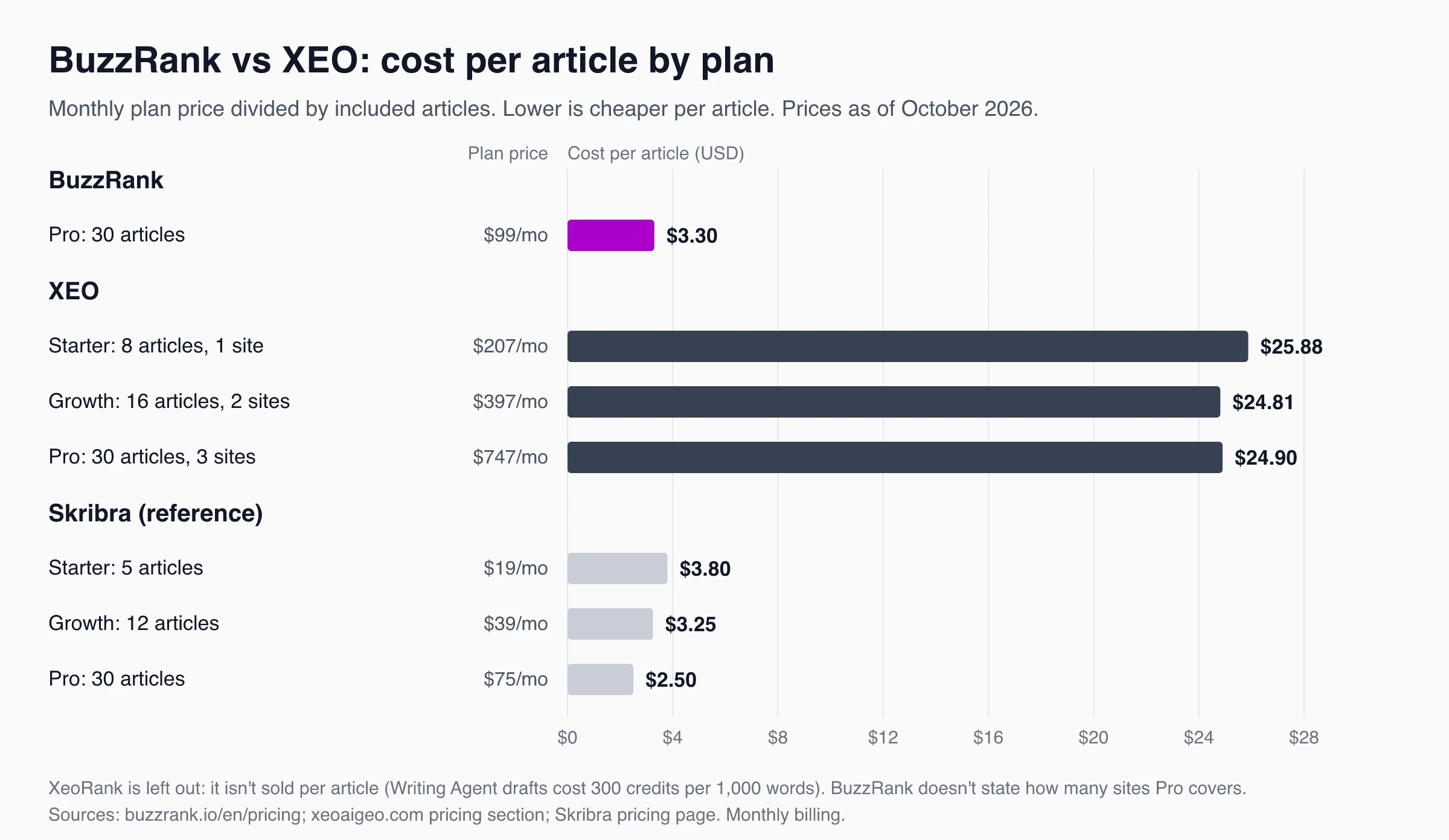
The gap is large. For 30 articles a month, BuzzRank costs $99 and XEO costs $747. XEO’s price covers up to three sites, the SEO health fixes and more CMS integrations, so it can make sense for a small agency. For one site that only needs articles, it’s hard to justify on price alone.
XeoRank’s costs depend on use. A 2,000-word draft costs 600 credits, about $0.60 at top-up rates, but you approve every page yourself. Its $19 to $109 per site buys monitoring, AI-visibility tracking and fixes, not output.
Backlink exchanges and Google’s link spam policy
Both autopilots in this comparison bundle link building based on exchanging links between customers. Before you turn it on, read what Google says. Its spam policies list these among examples of link spam:
- “Excessive link exchanges (“Link to me and I’ll link to you”) or partner pages exclusively for the sake of cross-linking”
- “Using automated programs or services to create links to your site”
- “Buying or selling links for ranking purposes”
Paid or sponsored links aren’t a violation when they’re marked with rel="sponsored" or rel="nofollow", which Google explains in its guide to qualifying outbound links. The appeal of an exchange is passing ranking value, though, and marking links that way removes it.
The vendors do describe safeguards. BuzzRank approves each request, verifies placement before credits settle, and requires links to stay live for 90 days. XEO says its links are “editorially placed within genuine, high-quality content”. Nobody outside Google can say how it treats either network: neither vendor publishes its network’s size, its domains or whether links are followed. And because BuzzRank credits can be bought with cash, a link earned with purchased credits is hard to tell apart from a bought one. The same question applies to other autopilots with link programs, such as Outrank; our comparison of Outrank and SEObot’s backlink programs covers both.
If you decide to try an exchange anyway:
- Start with it off. BuzzRank’s trial has no exchange, the exchange is optional on Pro, and XEO lets you opt out in settings.
- Check every placement by hand. Is the linking site on your topic, and would you link to it yourself?
- Watch Search Console. Check the Links report and the Manual actions report, which is where Google tells you if it has acted against unnatural links.
If you’d rather earn authority through content, our guide to content vs backlinks explains the trade-off, and the backlink glossary entry covers the basics.
Autopilot or approval: which tool fits which job
Pick by the job you need done, not by feature count.
Choose BuzzRank if
- You want a steady stream of new articles on one WordPress or API-connected site for under $100 a month.
- You’re happy to approve topics and let the rest publish itself.
- You want the option of a link exchange later, with verification before credits settle.
Skip it if you need native integrations beyond WordPress and webhook/REST.
Choose XeoRank if
- You manage several sites, or clients, and want one prioritized queue of SEO fixes.
- You care about whether ChatGPT, Gemini, Perplexity, Grok and Google’s AI Overviews mention you, and want that tracked weekly.
- Nothing should go live without a human saying yes.
Skip it if what you really need is more published articles each month. XeoRank says plainly that it isn’t an autopilot.
Choose XEO if
- You want an article autopilot that publishes to Wix, Webflow, Shopify, Lovable or Base44 as well as WordPress.
- You also want a site health score with bulk fixes in your WordPress SEO plugin.
- Your budget is around $200 a month or more, or you need two or three sites on one plan.
Skip it if cost per article matters most. At about $25 an article, it costs roughly 7.5 times what BuzzRank charges. Our roundup of Outrank’s alternatives covers more autopilots, most of them under $4 per article on their entry plans.
Where Skribra fits
Skribra is our product, so weigh this accordingly. It’s in the same category as BuzzRank and XEO. It researches keywords and writes long-form articles of 1,700 to 3,300 words with internal links and JSON-LD schema. It publishes to WordPress, Webflow, Notion, Shopify or any site via webhook or API and submits new URLs through IndexNow. You can approve each article or let them auto-publish. After publishing, a set of agents refreshes older articles, rewrites titles and descriptions that underperform, fixes stale references and adds internal links to newer posts.
Plans are $19/mo for 5 articles, $39/mo for 12 and $75/mo for 30, per project, and every plan includes a 3-day free trial.
What Skribra doesn’t do matters here too. There’s no backlink program or link exchange, no AI-visibility tracking like XeoRank’s, and no technical fix queue for your site. If those are your priority, XeoRank covers more of that ground. For other head-to-heads, see all our comparisons, or read AI SEO platform vs SEO suite if you’re still deciding between the two categories. We also compare other SEO autopilot tools like SEObot by cost per article.
How to decide in one week
- Name the job. If you need more articles, compare BuzzRank and XEO. If you need fixes and AI visibility for pages you already have, look at XeoRank.
- Trial the autopilots side by side, with drafts on. Point BuzzRank’s $1 trial and XEO’s 3 free days at the same site, then read 3 to 5 drafts from each for accuracy, sources and internal links. Use our list of autoblogging mistakes that trigger thin content issues as a checklist.
- Test XeoRank on real data. Run the free analysis or the 14-day Starter trial, then check whether the top items in its queue match what you see in Search Console.
- Test publishing on a staging site. Check formatting, images, schema and canonicals before anything reaches your live blog.
- Decide on backlinks separately. Treat the exchange as its own risk decision, not a bonus, and leave it off until you’ve seen where the links would come from.
Whichever tool you pick, recheck its pricing page before you subscribe. BuzzRank and XEO both show some inconsistent numbers on their own sites, so confirm the plan details in the app or with support.
Frequently Asked Questions
- What is BuzzRank?
- BuzzRank (buzzrank.io) is an SEO autopilot tool. It analyzes your site, plans keywords, writes and publishes SEO articles to WordPress or your own API, and runs an optional backlink exchange between its users. It is operated by a business registered in Poland.
- How much does BuzzRank cost?
- As of October 2026, BuzzRank has a $1 trial for 3 days with up to 5 articles, and one paid plan, Pro, at $99 a month. Pro includes 30 articles a month, publishing integrations and 100 backlink credits a month. Extra credits cost $100 for 200, $200 for 500 or $500 for 1,500.
- Is XeoRank the same as XEO?
- No. They are separate products with different websites, and neither mentions the other. XeoRank (xeorank.com) is an approval-first SEO and AI-visibility workspace from $19 a month per site. XEO (xeoaigeo.com) is an autopilot article tool with a backlink network, from $207 a month.
- Does XeoRank write and publish blog posts?
- XeoRank's Writing Agent drafts content on the Pro and Growth plans, priced in credits. But XeoRank never publishes on its own. Every change, including new pages, needs your approval, and new pages are saved as drafts first.
- Are BuzzRank's and XEO's backlink exchanges safe?
- No one outside Google can promise that. Google's spam policies list excessive link exchanges and automated link-building services as link spam. Both vendors describe safeguards, but neither publishes its network's domains. If you try one, start with it off, check placements by hand and watch Search Console for manual actions.
- Which of these tools has a free trial?
- XeoRank's Starter plan has a 14-day free trial with no card, and your first site analysis is free. XEO offers 3 days free, and its terms add a 14-day money-back guarantee. BuzzRank's trial costs $1 for 3 days.
Want Autopilot Without a Link Network?
If you want articles on autopilot but would rather skip link exchanges, Skribra researches keywords, writes long-form articles, publishes them to your CMS and keeps refreshing them after they go live.
Plans start at $19/month for 5 articles, and every plan comes with a 3-day free trial.
Written by
Skribra
This article was crafted with AI-powered content generation. Skribra creates SEO-optimized articles that rank.
Share: