July 7, 2026
·
Updated October 28, 2026
·
13 min read
Enterprise SEO Agency vs In-House Team: Which Scales?
Enterprise SEO agency vs in-house team, compared on speed, cost, capability, risk and collaboration. Includes a cost comparison built from BLS wage data (May 2025) and published SEO agency pricing surveys, the hybrid and embedded team models, an in-house SEO team structure by stage, and a scoring checklist to choose. Figures checked in October 2026.

An enterprise SEO agency usually scales faster in the first months: it arrives with specialists, tooling and a working process, so audits and roadmaps start in weeks instead of after a hiring cycle. An in-house SEO team scales further over time, because it owns the context, the backlog access and the standing permission to change templates. Many large companies end up with a hybrid: an in-house lead who owns strategy and engineering relationships, plus an agency or contractors for specialist depth and surge capacity.
Below: what "scale" should mean before you choose, what each model actually costs (using BLS wage data and published agency pricing surveys), how agencies add capacity without you hiring, how embedded and hybrid teams split the work, and how an in-house SEO team is usually structured as it grows.
The short answer: which model scales faster?
It depends on what is blocking you today. Pick the model that removes your current bottleneck, then revisit the choice once that bottleneck moves. The table is a decision framework based on how each model works, not survey data.
| Your main constraint | Usually scales faster | Why |
|---|---|---|
| You need results this year and have no SEO staff | Agency | Specialists, tools and playbooks are ready on day one; no hiring cycle |
| A specific skill gap (migrations, international, JavaScript SEO, digital PR) | Agency or specialist contractor | You buy depth you would use a few times a year |
| Recommendations pile up and never ship | In-house | The blocker is backlog access and influence, which outsiders borrow |
| Heavy legal, brand or compliance review | In-house lead (plus outside help) | Approvals move faster for someone inside the review chain |
| Many sites, markets or product teams | Hybrid | Central standards in-house, execution capacity bought in |
| Spiky workload (launches, replatforming) | Hybrid | Fixed headcount for the baseline, flexible capacity for peaks |
A quick test: if your biggest problem is “we don’t know what’s wrong,” buy expertise. If it is “we know, but can’t get it shipped,” build proximity.
Define what you’re scaling first
“Scale” means different things to different teams, and each meaning favors a different model:
- Coverage: more templates, locales and content types handled well.
- Velocity: shorter time from finding an issue to a fix in production.
- Quality: fewer regressions after releases and migrations.
- Throughput across teams: more SEO work shipped by product, content and engineering teams without the SEO lead in every meeting.
Write one sentence that says which of these matters most for the next 12 months and pick two or three metrics to judge it (for example, time from ticket to release, share of templates passing your checks, non-branded clicks from Search Console). Without that sentence, both models will look busy and neither will look successful.
What each model costs
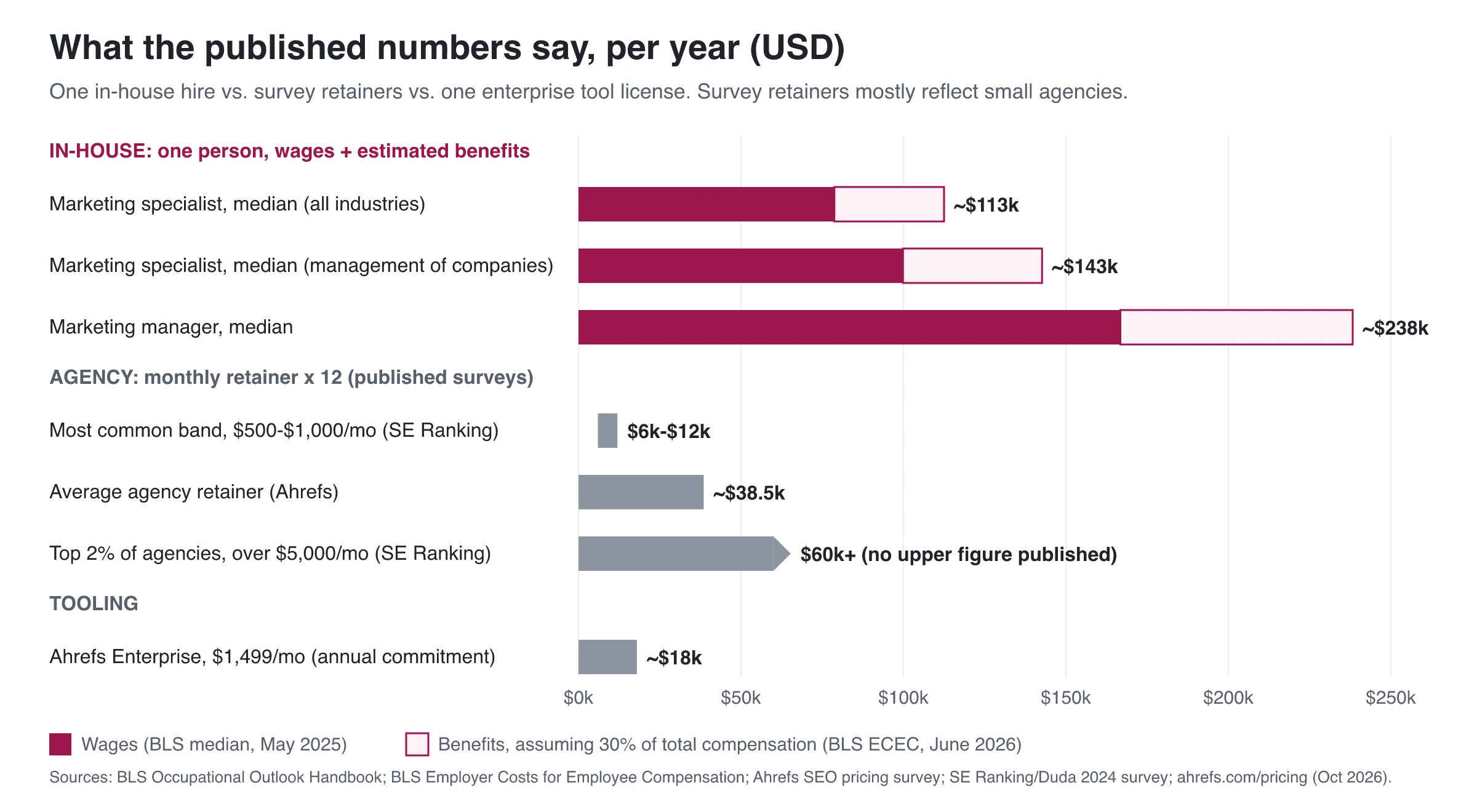
Cost comparisons go wrong in two ways: comparing a retainer to a salary instead of to a fully loaded team, and benchmarking an enterprise engagement against survey averages that mostly describe small agencies. The figures below are published numbers, each with its date.
In-house: salary is only part of the bill
The BLS doesn’t track “SEO specialist” as its own occupation. The closest category is market research analysts and marketing specialists, which includes search marketing strategists. Its median pay was $78,760 in May 2025, with the top 10% earning more than $155,480. The median is higher in the industries where enterprise SEO teams tend to sit: $99,850 in management of companies and enterprises and $102,670 in information. For a head of SEO, the nearest benchmark is marketing managers, with a median of $166,790 in the same survey.
Wages are about 70% of what an employee costs. In the BLS Employer Costs for Employee Compensation release for June 2026, benefits made up 30.0% of private-industry compensation. Applied to the all-industry and management-of-companies medians, one specialist costs roughly $113,000 to $143,000 a year and an SEO lead at the marketing-manager median roughly $238,000. A three-person team (one lead, two specialists at the management-of-companies median) comes to about $524,000 a year before tools, recruiting and management time.
Those are national medians. Senior technical SEOs in high-cost cities can cost well above them, so treat the numbers as a floor for planning, not a quote.
Agency: what retainer surveys do and don’t tell you
Two pricing surveys are widely cited:
- Ahrefs polled 439 SEO providers. 68.8% charge $2,000 a month or less, and the average retainer is $3,209 a month for agencies and $3,250 for consultancies. Average hourly rates were $98.90 for agencies and $171.18 for consultancies (Ahrefs, updated August 2024).
- SE Ranking and Duda collected pricing from 260 agencies: 170 survey responses plus 90 agencies listed in SE Ranking’s catalog (published December 2024). 64% charge under $1,000 a month and only 2% charge more than $5,000. Among US and Canadian agencies, 22% charge over $2,000 a month (SE Ranking).
Read these as a floor, not an enterprise benchmark. In the SE Ranking sample, 78% of respondents had fewer than 10 people, and neither survey breaks prices out by client size. Enterprise scopes (multiple sites, markets, migrations, engineering support) are usually quoted after discovery. The useful conclusion is narrower: an agency retainer can cost less than one in-house hire, but only if its scope is narrower than what that hire would do. Compare scopes and deliverables, not sticker prices.
Enterprise SEO consulting cost vs in-house
Consulting (a senior individual or small firm, often billed hourly or per project) sits between the two. At the Ahrefs survey’s $171.18 average consultancy rate, 20 hours a month is about $3,400, or roughly $41,000 a year. That buys judgment, not execution: audits, migration plans, roadmap reviews and training for your team. It is often the cheapest way to get senior input while a junior in-house hire or an agency does the work.
Tooling is a separate line in every model. Ahrefs lists its Enterprise plan at $1,499 a month with an annual commitment, and Semrush quotes enterprise pricing on request (both as of October 2026). Agencies often bring their own licenses; an in-house team needs its own, plus crawling, log analysis and dashboards. For what a typical agency SEO tool stack costs per client, see our breakdown. Ask any agency whether you keep the data and dashboards if the contract ends.
Hidden costs on both sides
- Agency: change requests outside scope, procurement and security reviews before work starts, onboarding time from your engineers and approvers, and knowledge that leaves with the contract.
- In-house: recruiting time for senior technical roles, management overhead, tools, training, and backfill when someone leaves. One resignation on a two-person team removes half the program.
- Both: engineering capacity. Neither model ships template fixes without developer time, and that cost rarely appears in either quote.
Speed to momentum: the first 90 days
Early speed is mostly about friction: access, approvals and who can ship a change. An agency starts faster only if your organization can feed it decisions and deployments.
| Period | Agency-led | In-house-led |
|---|---|---|
| Weeks 1-4 | Contract, procurement and access requests; discovery and crawl | Recruiting or reassigning people; tool purchases; scoping |
| Weeks 5-8 | Technical and content audit on key templates; prioritized roadmap | Audit and baseline; first tickets into the engineering backlog |
| Weeks 9-13 | Quick fixes handed to your teams; reporting cadence set | First fixes shipped through sprint planning; dashboards and annotations |
This timeline is a planning sketch, not a benchmark. Google’s own advice on hiring an SEO is to ask what results to expect, in what timeframe and how success will be measured, and to walk away from anyone who promises a #1 ranking: per Google Search Central, “no one can guarantee a #1 ranking on Google.”
Playbooks vs context
Agencies move faster on structured audits, prioritization frameworks and patterns seen across many clients. In-house teams move faster on knowing what will get approved, which platform quirks break things, and which product manager owns the template that is breaking canonicals. The fastest setup turns an agency’s playbooks into your context: agency audits, in-house ticket writing and sprint negotiation.
Handoff risks that fake speed
- Ownership is unclear between SEO, engineering and content, so recommendations wait for an owner.
- The vendor becomes the only operator of a critical system (redirect maps, hreflang, sitemaps).
- Teams “agree” in meetings and never schedule the work.
- Knowledge stays in slide decks instead of checklists, tests and templates.
If delivery depends on constant chasing, the problem is governance, not the model. See how enterprise SEO governance works for decision rights and the checks that keep standards enforced.
How agencies scale SEO without you hiring internally
When you add an agency, you are borrowing its capacity model. It is worth knowing how that capacity is built, because each lever has a limit:
- A bench of specialists. Technical SEOs, content strategists, analysts and digital PR people work across several clients, so you get part-time access to skills you couldn’t justify as full-time hires.
- Freelancers and contractors. Writing, editing and outreach are often subcontracted. Ask who actually does the work and how it is reviewed.
- Standardized playbooks. Audit templates, QA checklists and reporting formats cut setup time on every account.
- Automation and AI-assisted production. Many agencies now draft content and briefs with AI tools and spend human time on research, editing and fact-checking. That raises output; it also raises the risk of confident errors about your product, so require a source document of product facts and a named reviewer for each page.
- Elastic staffing. Agencies can move people onto your account for a migration or launch and off again afterwards. Your own team can’t.
What none of these levers can supply: access to your release process, standing in your planning meetings, and authority to change shared templates. Those still have to come from you, through an internal owner with time set aside for the agency.
What changes for SaaS and product-led companies
In SaaS, the pages that matter most (feature, integration, comparison and pricing pages) depend on product details that change every release. That shifts the balance toward in-house ownership of accuracy, even when an agency produces the drafts. A practical split: the agency handles research, briefs, drafts and technical audits; a product marketer or SEO lead inside the company approves every claim about features, pricing and security. Track SEO through to trials and demos, not only traffic, using the content marketing metrics that tie SEO to revenue.
Hybrid and embedded growth teams
Many enterprises don’t pick one model. They combine them, and the useful question becomes who owns which decision.
- Classic agency engagement: the agency delivers audits, recommendations and reports; your teams decide whether and when to implement.
- Embedded growth team: agency or contract staff work inside your product squads, attend sprint planning and standups, and write tickets in your tracker. It costs more per head than a classic retainer but removes the handoff that kills most recommendations.
- In-house center of excellence: a central SEO team owns standards and tooling, with SEOs embedded in product teams. Outside help covers specialist projects.
| Workstream | Typical in-house owner | Commonly bought in |
|---|---|---|
| SEO strategy, priorities, budget | SEO lead | Senior consultant for review |
| Technical SEO standards and release checks | Technical SEO with platform engineering | Audits, migration planning |
| Content strategy and keyword ownership | Content SEO lead | Research, briefs, drafting, editing |
| Digital PR and link earning | Comms or PR team | Campaigns and outreach |
| International SEO and hreflang | Central SEO team | Market-specific research and localization |
| Measurement and dashboards | Analyst or data team | Dashboard setup |
One rule makes hybrids work: one shared backlog, one set of definitions and one reporting layer. Two roadmaps, one per vendor, produce duplicated audits and conflicting tickets.
Embedded growth team vs agency: how to choose
Choose an embedded team when the work is mostly implementation inside your product (templates, internal linking modules, structured data, programmatic pages) and engineers are the bottleneck. Choose a classic agency when the work is mostly analysis, content production or PR that can be delivered as documents and assets. If you can’t give outside people access to your tracker and planning rituals, an embedded model will behave like a classic agency anyway, at a higher price.
In-house SEO team structure
In-house teams tend to grow in three stages. The roles below are a common pattern rather than a benchmark, and the dashed boxes show work that is often bought in at each stage.
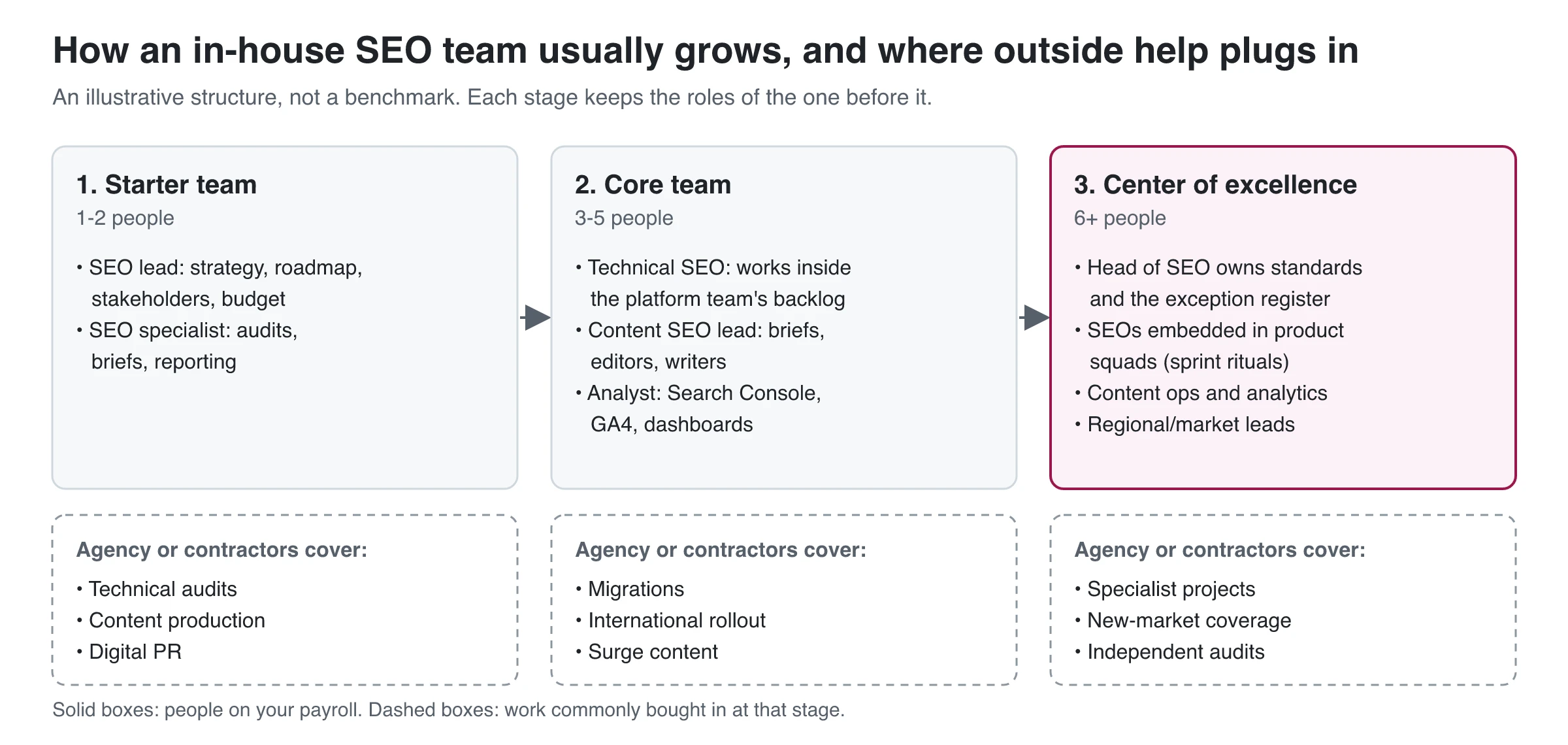
- Starter team (1-2 people): an SEO lead who owns strategy and stakeholders, plus a specialist for audits, briefs and reporting. Outside help covers technical audits, content production and PR.
- Core team (3-5): adds a technical SEO who works inside the platform team’s backlog, a content SEO lead and an analyst. Migrations and international rollouts are still often bought in.
- Center of excellence (6+): a head of SEO owns standards and exceptions, SEOs sit in product squads, and content operations and analytics are dedicated roles. Outside help shifts to specialist projects and independent audits.
Where SEO reports matters less than whether it has written decision rights with engineering and product. A team under marketing with an agreed SLA for SEO tickets can ship more than a team under engineering that has no say over content.
Governance, access and risk
Large-company SEO is as much about safe change as good ideas, and the model you choose changes who carries the risk.
- Access: give every person their own account, read-only by default. Google’s guidance for audits is to grant read-only Search Console access, not write access, and Search Console’s user and permission levels make that easy to do per person. Remove access as part of offboarding, whichever model you use.
- Accountability: Google is explicit that you are responsible for what an SEO you hire does on your site. Ask any agency to explain each change and the reason for it, and keep a change log with sign-offs.
- Brand and compliance: in regulated industries, keep approved wording, required disclosures and the evidence behind claims inside the company, even when drafting is outsourced.
- Release safety: technical changes should go through a change brief, impact review, monitored rollout and a rollback plan. The list of enterprise SEO mistakes that waste crawl budget shows what goes wrong when they don’t.
Google’s Search Central team covers what to ask before hiring and the warning signs to watch for in this video. It dates from 2017, and its advice matches Google’s current hiring guide:
How to decide: a five-question scorecard
This scorecard is a rule-of-thumb framework, not a validated model. Score each question from 1 (favors agency) to 5 (favors in-house), then add them up.
- Timeline: do you need visible progress within two quarters (1) or can you invest for a longer ramp (5)?
- Skill gaps: do you need several specialist skills occasionally (1) or a few core skills every day (5)?
- Implementation path: can recommendations ship without someone inside the sprint process (1), or do they stall without one (5)?
- Review load: are approvals light (1) or do legal, brand and product review most pages (5)?
- Workload shape: is demand spiky, driven by launches and migrations (1), or steady (5)?
A total of 5-11 points toward an agency-led model, 12-18 toward a hybrid with an in-house lead, and 19-25 toward building in-house. Whichever you choose, write down the intake rules, cadence, decision owners and handoff points before the first audit starts. For a baseline of what the work covers, see Skribra’s SEO guide and this walkthrough of a technical SEO audit.
Choose the Model That Removes Your Bottleneck
- Write one sentence defining what you need to scale (coverage, velocity, quality or cross-team throughput) and pick two or three metrics for it.
- Price both options on scope: a fully loaded in-house team against an agency proposal with named deliverables, plus tools and engineering time in both.
- Choose an agency for speed and specialist breadth, in-house for context and influence, and a hybrid when you need both. Many large companies land on the hybrid.
- Put one shared backlog, decision log and reporting layer in place before work starts, and review the model again after two quarters.
Frequently Asked Questions
- How much does an enterprise SEO agency cost?
- There is no published enterprise benchmark. Enterprise scopes are usually quoted after discovery. The broad surveys skew small: Ahrefs reports an average agency retainer of about $3,209 a month, and in SE Ranking's 2024 survey only 2% of agencies charged more than $5,000 a month. Compare proposals on scope and deliverables rather than against those averages.
- Is an in-house SEO team cheaper than an agency?
- Not at small scale. One marketing specialist at the BLS median for management of companies ($99,850 in May 2025) costs roughly $143,000 a year with benefits. In-house becomes better value when the work is continuous, needs deep product context, and would otherwise need several agency workstreams at once.
- What is an embedded growth team?
- It is agency or contract staff who work inside your product teams: they attend sprint planning, write tickets in your tracker and ship changes with your engineers. It costs more than a classic retainer but removes the handoff where most SEO recommendations stall.
- How should an in-house SEO team be structured?
- Start with an SEO lead and one specialist, then add a technical SEO who works in the platform team's backlog, a content SEO lead and an analyst. Larger organizations move to a central team that owns standards, with SEOs embedded in product squads.
- Can an agency and an in-house team work together without duplicating work?
- Yes, if ownership is split by workstream and both work from one backlog with one set of definitions and one report. A common split is in-house for strategy, standards and implementation, with the agency on audits, content production or digital PR.
Add Content Capacity Without Adding Headcount
If content production is the part of your SEO program that won’t scale, Skribra researches keywords, writes long-form articles with internal links and publishes them to your CMS. You can approve each article before it goes live, and agencies can run each client as a separate project with its own keywords and brand voice. Skribra doesn’t build backlinks, so keep link earning with your PR team or agency.
Plans start at $19/month for 5 articles, billed per project, and every plan comes with a 3-day free trial.
Written by
Skribra
This article was crafted with AI-powered content generation. Skribra creates SEO-optimized articles that rank.
Share: