October 2, 2026
·
Updated October 28, 2026
·
16 min read
SEO Content Marketing: What It Is and How It Works
A practical guide to SEO content marketing: what it is, how SEO and content marketing work together, and a six-step process for planning, publishing, measuring and refreshing content that ranks and converts.


SEO content marketing is the practice of choosing content topics from what your audience searches for, then creating, publishing and maintaining pages that rank for those searches and move readers toward becoming customers. SEO decides which questions are worth answering and makes the answers findable. Content marketing makes them worth reading and connects them to your business.
This guide covers how the two disciplines fit together, a six-step process from keyword to refresh, which content types fit each stage of the funnel, how to measure results, who does what on a team, and the mistakes that stall most programs. Where a topic deserves more depth, the section links to a dedicated guide.
What is SEO content marketing?
SEO content marketing combines two disciplines that are usually defined separately:
- SEO (search engine optimization) is, in Google’s words, about helping search engines understand your content and helping people find your site and decide whether to visit it. That’s the framing of Google’s SEO Starter Guide.
- Content marketing is defined by the Content Marketing Institute as a strategic approach built on creating and distributing valuable, relevant, consistent content that attracts and keeps a clearly defined audience, and ultimately drives profitable customer action.
Put them together and you get a program where search demand picks the topics, and the quality of the content earns both the ranking and the conversion.
SEO content is a single page made inside that program: a page written to answer a specific search query well enough to rank, and usefully enough that the reader takes a next step. A product announcement or an event recap is content marketing, but it usually isn’t SEO content, because nobody is searching for it.
Other names for the same work: content-driven SEO and SEO-driven content marketing.
SEO vs. content marketing: how they differ
| SEO | Content marketing | SEO content marketing | |
|---|---|---|---|
| Main question | Can people find us in search? | Do people trust and choose us? | Which searches should we win, and with which page? |
| Channels | Organic search, including the AI answers built on it | Search, email, social, communities, sales | Organic search first; other channels for distribution |
| Unit of work | Keywords, pages, the site’s technical health | Stories, assets, campaigns | Topic clusters and the pages inside them |
| Time horizon | Months, and it compounds | A campaign, or ongoing | Months, and it compounds, with refresh cycles |
| Success measure | Impressions, rankings, clicks | Engagement, leads, revenue | Clicks from target queries that turn into leads or sales |
SEO without content marketing tends to produce pages that match a keyword and convince no one. Content marketing without SEO tends to produce good pieces that get a burst of traffic on launch day and very little after it. The combination fixes both: search keeps sending readers long after launch, and the content gives them a reason to stay and act.
How content marketing helps SEO, and how SEO helps content
The two feed each other in four concrete ways:
- Content is what search ranks. Google’s starter guide says content people find compelling and useful will likely influence your search presence more than any of its other suggestions.
- Useful pages earn references. Original data, clear explanations and good tools are what other sites cite and link to, which is how a site builds authority.
- Search data replaces guesswork. Queries show the exact words and problems your audience has, and Search Console shows which pages already earn attention. That beats a brainstorm as input for an editorial plan.
- Search extends shelf life. A post promoted only on social fades in days. A post that ranks keeps getting readers for as long as it stays the best answer.
How search turns content into traffic
Before any content can bring traffic, it has to make it through Google’s pipeline: Google finds the URL (through links and XML sitemaps), crawls it, decides whether to index it, and then chooses whether to show it for a given query. Most content problems are really a problem at one of four stages:
| Stage | What has to be true | The content team’s job | Typical blocker |
|---|---|---|---|
| Discovery | Google can find the URL | Link every new page from its pillar and related posts; keep it in the XML sitemap | Orphan pages that nothing links to |
| Indexing | The page is crawlable, returns HTTP 200, isn’t set to noindex, and adds something new | Avoid near-duplicate pages; check important new URLs in Search Console | Accidental noindex; thin or duplicate pages |
| Relevance | The page matches the intent behind the query | Brief from the live results page; answer the question early | Right topic, wrong format or angle |
| Authority | Google trusts the page enough to rank it above others | Publish original, citable material; cover the topic in depth | Shallow coverage; nothing on the web references the page |
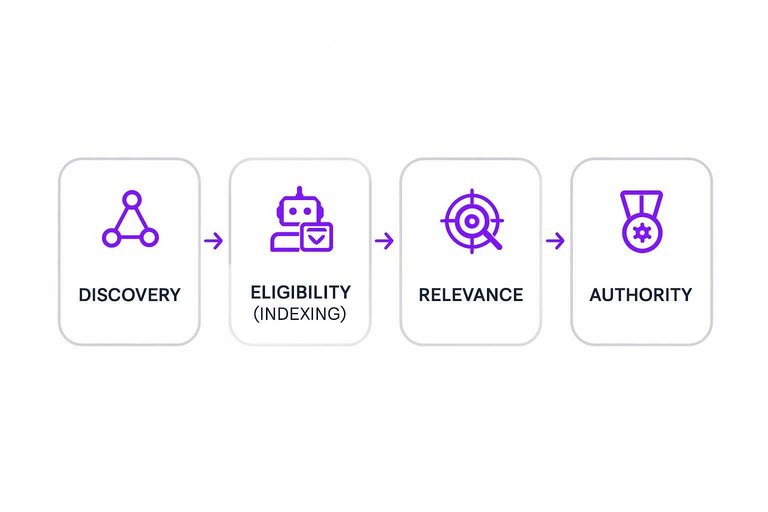
The stage a page is stuck at tells you what to fix. If it isn’t indexed, start with why Google doesn’t index a page. If it’s indexed but buried, the problem is relevance or authority, and the strategy below is how you fix it. The technical baseline (crawlability, site speed, structured data) is covered in the complete SEO guide.
How to build an SEO content marketing strategy in 6 steps
A working SEO content marketing strategy is a loop, not a launch. You run these six steps for one topic cluster at a time, and what you learn in step 6 becomes the input for the next round of step 1.
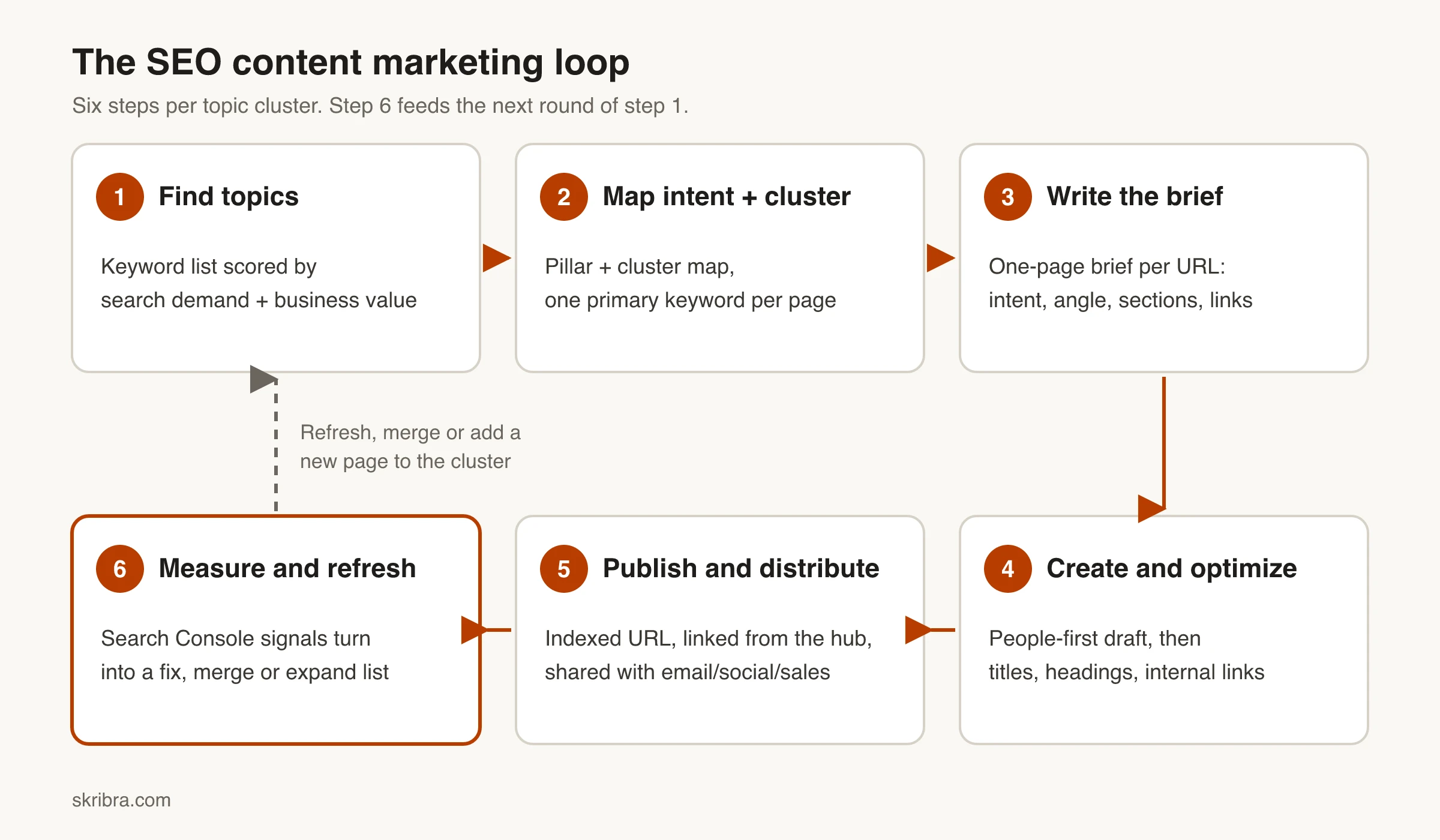
Step 1: Find topics with search demand and business value
Build a long list of candidate topics from four places:
- A keyword research tool, for search volume and keyword difficulty.
- Google Search Console, for queries you already get impressions for but rank poorly on. These are often the quickest wins because Google already associates you with them.
- Sales and support conversations, for the questions customers actually ask before buying.
- Competitors’ top pages, for topics your market already searches for.
Then score each topic for business value, not just volume. Ahrefs describes a simple version in its SEO content marketing process: rate each topic from 0 to 3 by how naturally your product fits into the answer, and prioritize the 2s and 3s. For a project-management tool, “best project management software for agencies” is a 3, because the product is the answer. “How to run a retrospective” might be a 1: relevant to the audience, but the product is a passing mention.
High business value with realistic difficulty goes to the top of the list. High volume with no business value is usually traffic you can’t use.
Step 2: Map keywords to intent and group them into topic clusters
For every keyword on your list, search it and look at what ranks. The results page tells you the search intent (learning, comparing, buying, or finding a specific site) and the format Google rewards: list posts, step-by-step guides, comparison tables, product pages or tools. If the top ten are all “best X” lists, a single-product landing page won’t break in.
Next, group keywords that one page can satisfy. A practical rule of thumb: if the same URLs rank for two queries, one page should target both. Then organize the groups into a topic cluster: a content pillar page that covers the broad term, plus cluster pages that each go deep on one narrower query, all linked to each other.
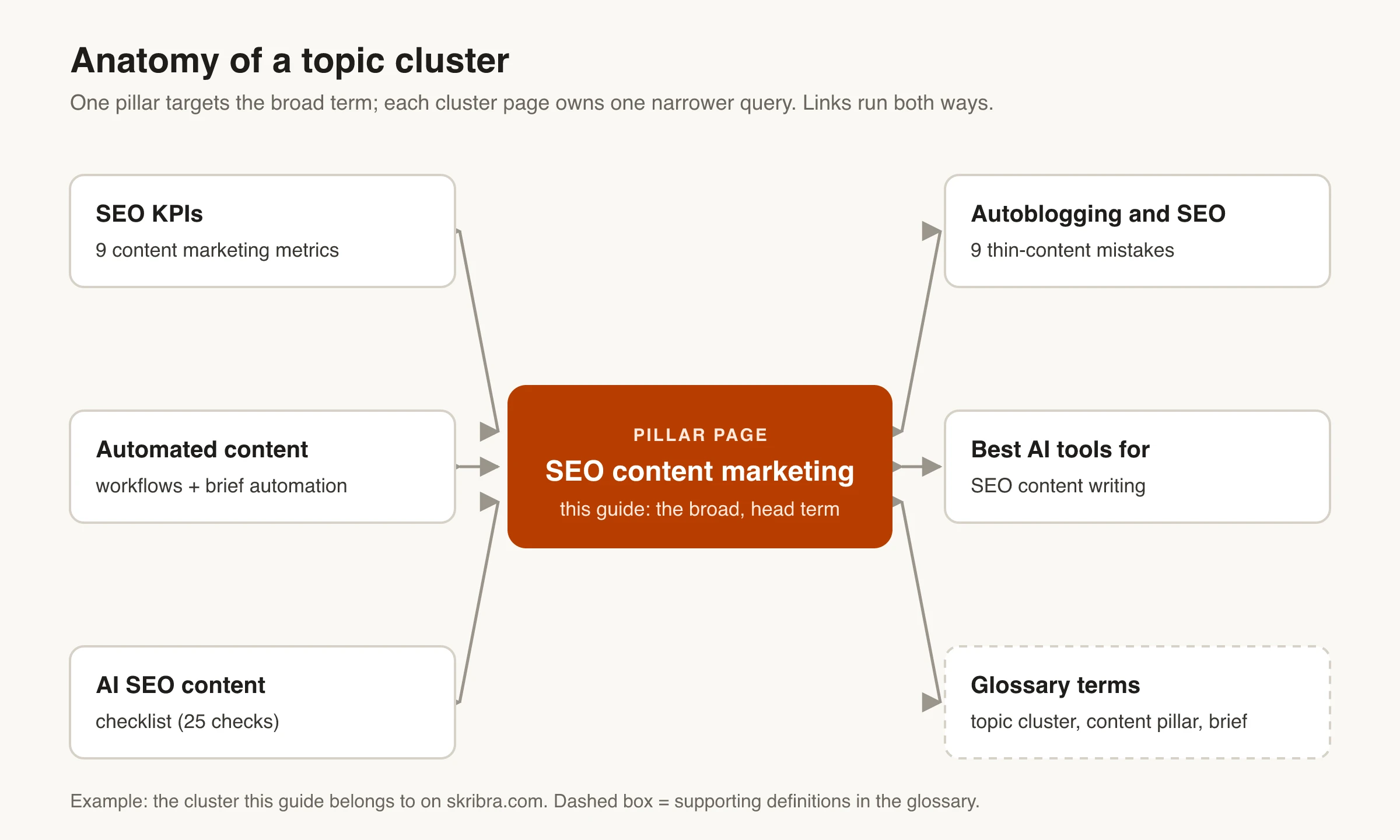
Record the result in a keyword map: one row per URL with its primary keyword, secondary keywords, intent and status. The rule that matters most is one primary keyword per URL. When two of your pages chase the same query, they can split the signals and both rank worse than one strong page would, which is called keyword cannibalization.
Ahrefs’ video on content hubs walks through the same pillar-and-cluster structure with examples:
Step 3: Write a brief for every page
A content brief turns a keyword into instructions a writer (or an AI model) can follow without guessing. One page is enough. It should answer:
- Target query: the primary keyword plus 2 to 5 secondary ones from the keyword map.
- Intent and format: what the searcher wants and the format that ranks today.
- Reader and next step: who is searching, and what you want them to do after reading.
- Angle: what this page will have that the ranking pages don’t, such as first-hand data, worked examples, a template, a tool or simply a clearer answer.
- Outline: H2s and H3s that mirror the real questions people ask (People Also Ask boxes and Search Console queries are good sources).
- Facts to verify: every number or claim the page will make, with the source to check it against.
- Links: the pillar and sibling pages to link to, and which existing pages should link back.
Briefs are one of the easiest steps to automate, because most inputs are data. The guide to automated content workflows shows how teams do it, from keyword to brief to cited draft.
Step 4: Create people-first content, then optimize the page
Google’s guidance on helpful, people-first content is the best quality bar there is, because it’s the bar Google says it’s trying to measure. It suggests judging every page by who created it, how it was made, and why it exists. It also says SEO is a helpful activity when it’s applied to people-first content, and that Google has no preferred word count.
In practice, that means:
- Answer first. Give the direct answer in the first two or three sentences, then the detail.
- Be specific. Use real numbers with sources, screenshots, steps and examples rather than general advice.
- Show experience. Say who wrote it and why they know the subject, and add what only you can (your data, your process, your product’s real limits).
- Structure for scanning. One H1, H2s that match the questions, short paragraphs, tables for comparisons.
Then do the on-page basics: the primary keyword in the title tag and H1, a meta description that sells the click, a short descriptive URL, internal links with descriptive anchor text, and alt text on images. If AI wrote the first draft, run it through the AI SEO content checklist before it goes live; it covers intent, facts, trust signals, on-page SEO and links in 25 checks.
Step 5: Publish, get indexed and distribute
Publish on a predictable schedule from a content calendar that is organized by cluster, so clusters get finished instead of left half-built. On the day a page goes live:
- Link to it from the pillar and from two or three related pages, so it isn’t an orphan.
- Check discovery: make sure it’s in your XML sitemap, and inspect important URLs in Search Console.
- Distribute it. Send it to your email list, post it where your audience already asks the question (social, communities, forums), and give it to your sales and support teams as a ready-made answer. This is the “marketing” half of SEO content marketing, and it gets a page read, shared and referenced before it ranks.
- Repurpose it. A guide can become a checklist, a short video or a sales one-pager.
Step 6: Measure, then refresh, merge or expand
Google’s starter guide notes that some changes take effect in a few hours and others take several months, so judge a page on trends over weeks, not days. Once a page has data, match the signal to the action:
| Signal in Search Console | Likely cause | What to do |
|---|---|---|
| Many impressions, low CTR | The title and snippet don’t match what searchers want | Rewrite the title tag and meta description around the query’s intent |
| Ranking around positions 8 to 20 | Relevant, but not the best answer yet | Add missing subtopics, examples and internal links from stronger pages |
| Clicks falling for months | Outdated facts, or competitors published better pages | Refresh facts, examples and screenshots; recheck the results page for format changes |
| Two of your pages rank for the same query | Keyword cannibalization | Merge them into one page and 301-redirect the other URL |
| No impressions after several months | No demand, or the wrong keyword | Retarget the page, or merge and redirect it |
| Impressions for queries you never targeted | New demand you’re close to winning | Add a section, or plan a new cluster page |
One rule: don’t fake freshness. Google’s helpful-content guidance lists changing a page’s date without substantially changing the content as a warning sign. Refresh when there’s something to update, and say what changed.
SEO content types for each stage of the funnel
Different searches happen at different points in the buying journey. A healthy program covers all of them, and each stage needs its own content type and its own measure of success:
| Funnel stage | What the searcher wants | Content types that fit | Example queries | Judge it by |
|---|---|---|---|---|
| Awareness | Understand a problem or a term | Glossary definitions, explainers, beginner guides | “what is a topic cluster” | Impressions, clicks, email sign-ups |
| Consideration | Learn how to solve it | How-to guides, checklists, templates, free tools | “seo content brief template”, “how to check keyword rankings” | Engaged visits, tool use, assisted conversions |
| Decision | Pick a product | “X vs Y” comparisons, alternatives, best-of lists, pricing pages | “outrank vs seobot”, “seobot alternatives” | Trials, demos, sales |
| Retention | Get more out of the product | Docs, tutorials, integration guides | “connect [tool] to WordPress” | Activation, fewer support tickets |
New programs often over-invest in awareness content because it has the biggest search volumes. Decision-stage queries are smaller, but the searcher is already choosing, so those pages usually do more for revenue. If you earn commissions instead of selling your own product, see how SEO for affiliate marketing handles review and comparison pages. A sensible order is to cover decision and consideration queries where you have a real product answer, then build awareness content around them as the pillar.
How to measure SEO content marketing
Measure SEO content marketing at three levels: the page, the cluster (add up every URL in it) and the program as a whole. Each metric answers one question:
| Question | Metric | Where to find it |
|---|---|---|
| Do we show up? | Impressions and average position for target queries | Search Console Performance report |
| Do searchers choose us? | Click-through rate | Search Console Performance report |
| Are we getting visits? | Clicks and organic sessions | Search Console and GA4 |
| Does it pay? | Conversions and assisted conversions from organic landing pages | GA4 or your CRM |
| Is the library healthy? | Indexed pages; pages whose clicks are falling | Search Console Page indexing and Performance reports |
| Do AI answers show us? | Impressions in AI Overviews and AI Mode | Search Console’s generative AI performance report |
Google counts clicks and impressions from AI features inside the normal Web search type of the Performance report, so AI traffic isn’t missing from your totals. The separate generative AI performance report isolates impressions from those features by page, country and device. The Search Console guide explains what each report measures.
For the full list of KPIs, with a definition, data source and the decision each one drives, plus a dashboard layout, see 9 SEO content marketing metrics worth tracking. The short version: report by cluster, tie at least one metric to revenue, and review the refresh signals from step 6 every month.
Who does what: roles on an SEO content team
SEO content marketing needs six jobs done. In a large team each is a role; in a small one, one person may cover three of them. What matters is that every step of the loop has an owner. If you’re deciding whether to staff it yourself or hire out, see agency vs in-house SEO.
| Role | Owns | In a small team |
|---|---|---|
| Content strategist or SEO lead | Keyword research, clusters, the keyword map, priorities | Usually the founder or the marketing lead |
| Writer | Drafts from briefs | Freelancers, or AI drafts with a human editor |
| Editor or subject-matter expert | Accuracy, first-hand experience, voice | Whoever knows the product or field best, in a short review pass |
| Technical SEO owner | Indexing, site speed, structured data, redirects | A developer on call |
| Distribution owner | Email, social, communities, sales enablement | The marketer who runs your channels |
| Analyst | Reporting and the refresh queue | The strategist, once a month |
The job that most often has no owner is step 6. Teams publish, move on, and a year later have a library of slowly decaying pages. Put the monthly refresh review on someone’s calendar before you publish the first article.
Where automation fits
Much of the loop is data work, and data work can be automated: keyword research, brief assembly, first drafts, internal-link suggestions, publishing and performance monitoring. Choosing the angle, checking facts, adding first-hand experience and building relationships for distribution still need people. The guide to AI tools for SEO content writing compares the options by how much of the job they take over, with October 2026 pricing.
Skribra, the product behind this blog, automates most of the loop for each site you connect. It pulls keywords from DataForSEO, builds a rolling 30-day content calendar, writes long-form articles with internal links, and publishes them to WordPress, Webflow, Notion, Shopify or a webhook. After publishing, its maintenance agents refresh pages based on search performance, rewrite titles and descriptions that underperform, and flag articles that compete for the same query. How it works shows each step. What it doesn’t do: email or social distribution, or link building. You should still review facts on any page that matters to your business.
SEO content marketing in the AI era
AI changed how content gets produced and how search results look. It didn’t change what Google rewards.
- AI-assisted content is allowed; scaled spam isn’t. Google’s spam policies define scaled content abuse as generating many pages mainly to manipulate rankings rather than help users, and list using generative AI to produce many pages without adding value as an example. Who or what wrote the page isn’t the test; value to the reader is.
- No special AI optimization exists. Google’s page on AI features and your website says there are no additional requirements or special optimizations to appear in AI Overviews or AI Mode, and that SEO best practices still apply.
- Simple answers get answered on the results page. When a query has a one-line answer, fewer people may click through. Pages that offer more than the summary (original data, tools, worked examples, comparisons, first-hand experience) give people a reason to visit.
The practical rule: use AI for research and first drafts, and people for angle, facts and a review before anything goes live. Here’s how AI and human writers split the work on a typical SEO article. The breakdown of autoblogging mistakes that cause thin content shows what goes wrong when that review step is skipped and how to clean it up.
Common SEO content marketing mistakes
These are the patterns that keep SEO content programs stuck on page five:
- Choosing topics by volume alone. Big keywords with no link to your product bring visitors who never buy. Score business value in step 1.
- Writing before checking the results page. If Google ranks comparison tables and you write an essay, you won’t rank. Let the results page set the format.
- One page per keyword variation. “SEO content strategy” and “content SEO strategy” are one topic. Separate pages split signals and look thin. Map keywords to URLs first.
- Publishing orphan pages. A page nothing links to is hard for Google and readers to find. Link every new page from its pillar on day one.
- Publishing and walking away. Content decays as facts age and competitors improve. Run the step 6 review every month.
- Faking freshness. Updating the date without updating the content is a warning sign Google names explicitly. Change the substance, or leave the date alone.
- Measuring traffic only. Traffic that never converts can hide a strategy problem. Track at least one revenue-linked metric per cluster.
- Scaling AI output without review. Mass-produced pages with no added value fall under Google’s scaled content abuse policy. Keep a human checkpoint.
- Skipping distribution. New pages can take weeks or months to rank. Email, social and sales use are what get them read, shared and cited in the meantime.
Start with one cluster
You don’t need a 100-page plan to start. Pick one topic where your product is genuinely the answer. Map the queries around it into a pillar and a handful of cluster pages, write a brief for each, and publish them linked to one another. Then review Search Console every month and refresh, merge or expand based on what it shows.
The teams that win at SEO content marketing aren’t the ones that publish the most. They’re the ones that keep running the loop.
Frequently Asked Questions
- What is SEO content marketing?
- SEO content marketing is the practice of choosing content topics based on what your audience searches for, then creating, publishing and updating pages that rank for those searches and lead readers toward becoming customers. SEO supplies the demand data and makes pages findable; content marketing makes them useful and connects them to the business.
- What is the difference between SEO and content marketing?
- SEO is about making your site visible in search results: keywords, technical health, rankings and clicks. Content marketing is about creating and distributing content that attracts and keeps an audience across every channel, including email and social. SEO content marketing is where they overlap: content planned around search demand and built to rank and convert.
- How does content marketing help SEO?
- Content is what search engines rank, so useful pages that match search intent are the main way to win new queries. Good content also earns references from other sites, and related pages linked into topic clusters help search engines find and understand them. Without content, SEO has little to optimize beyond the homepage and product pages.
- What is SEO content management?
- SEO content management is the ongoing upkeep of the content you have already published: keeping a keyword map so each page owns one query, refreshing pages whose traffic is falling, merging overlapping pages and redirecting the extras, and fixing internal links. It is step 6 of the SEO content marketing loop, and it is the step most teams skip.
- How long does SEO content marketing take to work?
- Expect months rather than weeks. Google's SEO Starter Guide says some changes take effect within hours while others take several months. Judge a page on its trend over several weeks, and use email and social distribution to get it read in the meantime.
- Does SEO content marketing still work with AI search?
- Yes. Google says there are no special requirements or optimizations for appearing in AI Overviews or AI Mode, and that SEO fundamentals still apply. What has changed is that simple factual questions are often answered on the results page, so pages need to offer more than a summary, such as original data, tools, examples or first-hand experience.
Run the whole loop on autopilot
If you would rather not run every step by hand, Skribra researches keywords, plans a content calendar, writes and publishes articles to your CMS, and keeps refreshing them as search performance changes.
Plans start at $19/month for 5 articles, and every plan comes with a 3-day free trial.
Written by
Skribra
This article was crafted with AI-powered content generation. Skribra creates SEO-optimized articles that rank.
Share: